Skip to Content
MilliporeSigma

202134

Cesium iodide

99.9% trace metals basis

Synonym(s):

Caesium iodide, Caesium monoiodide

Sign In to View Organizational & Contract Pricing

Select a Size


About This Item

Empirical Formula (Hill Notation):
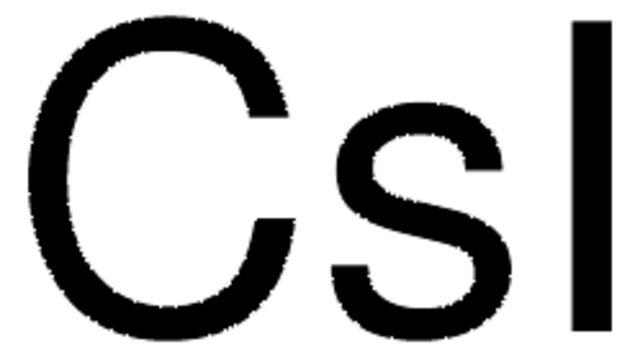
CsI
CAS Number:
Molecular Weight:
259.81
EC Number:
MDL number:
UNSPSC Code:
12352302
PubChem Substance ID:
NACRES:
NA.23
Assay:
99.9% trace metals basis
Form:
powder
Technical Service
Need help? Our team of experienced scientists is here for you.
Let Us Assist
Technical Service
Need help? Our team of experienced scientists is here for you.
Let Us Assist

Quality Level

assay

99.9% trace metals basis

form

powder

impurities

≤1500.0 ppm Trace Metal Analysis

mp

626 °C (lit.)

density

4.51 g/mL at 25 °C (lit.)

SMILES string

[I-].[Cs+]

InChI

1S/Cs.HI/h;1H/q+1;/p-1

InChI key

XQPRBTXUXXVTKB-UHFFFAOYSA-M

Looking for similar products? Visit Product Comparison Guide

Related Categories

Application

Cesium iodide (CsI) can be used as a cathode for the fabrication of field emission cathodes for potential usage in high power microwave systems. It can also be used to form an interface layer between the blocking layer and the perovskite active layer to improve the photovoltaic performance and stability of solar cells.

Features and Benefits

  • High purity of ≥99.995% Copper(II) chloride minimizes impurities, boosting efficiency and selectivity in catalytic processes essential for organic synthesis and industrial chemical production.
  • The presence of low metal impurities in ≥99.995% copper(II) chloride ensure consistent quality in electroplating applications, enhancing adhesion and achieving uniform coatings on substrates without contamination that could compromise the finish.
  • Anhydrous CuCl₂ reduces the risk of hydrolysis, preventing unwanted by-products and enhancing the efficiency of chemical processes.
Frequently used in devices such as phosphor screens for medical imaging, scintillators, calorimeters and a variety of particle detectors.

pictograms

Health hazardEnvironment

signalword

Warning

Hazard Classifications

Aquatic Acute 1 - Repr. 2

Storage Class

13 - Non Combustible Solids

wgk_germany

WGK 2

flash_point_f

Not applicable

flash_point_c

Not applicable

ppe

dust mask type N95 (US), Eyeshields, Faceshields, Gloves


Choose from one of the most recent versions:

Certificates of Analysis (COA)

Lot/Batch Number

Don't see the Right Version?

If you require a particular version, you can look up a specific certificate by the Lot or Batch number.

Already Own This Product?

Find documentation for the products that you have recently purchased in the Document Library.

Visit the Document Library

Comparison of velvet-and cesium iodide-coated carbon fiber cathodes
Shiffler D, et al.
IEEE transactions on nuclear science, 29(3), 445-451 (2001)
Olga Nazarenko et al.
Inorganic chemistry, 56(19), 11552-11564 (2017-09-13)
Interest in hybrid organic-inorganic lead halide compounds with perovskite-like two-dimensional crystal structures is growing due to the unique electronic and optoelectronic properties of these compounds. Herein, we demonstrate the synthesis, thermal and optical properties, and calculations of the electronic band
Low level plasma formation in a carbon velvet cesium iodide coated cathode
Shiffler D, et al.
Physics of Plasmas, 11(4), 1680-1684 (2004)
Taehwan Jun et al.
Advanced materials (Deerfield Beach, Fla.), 30(43), e1804547-e1804547 (2018-09-15)
Halide perovskites, including CsPbX3 (X = Cl, Br, I), have gained much attention in the field of optoelectronics. However, the toxicity of Pb and the low photoluminescence quantum yield (PLQY) of these perovskites hamper their use. In this work, new
Longkai Yang et al.
Journal of colloid and interface science, 534, 459-468 (2018-09-25)
Oriented TiO2 nanorod array (TiO2 NA) is very attractive in the fields of halide perovskite solar cells (PSCs) due to its fewer grain boundaries and high crystallinity for effective charge collection. The optimization of TiO2 nanostructures has been proved to

Articles

Colloidal quantum dots (CQDs) are semiconducting crystals of only a few nanometers (ca. 2–12 nm) coated with ligand/surfactant molecules to help prevent agglomeration.

Our team of scientists has experience in all areas of research including Life Science, Material Science, Chemical Synthesis, Chromatography, Analytical and many others.

Contact Technical Service