Skip to Content
MilliporeSigma

MAB5404

Sigma-Aldrich

Anti-Nitrotyrosine Antibody, clone 2A8.2

clone 2A8.2, Chemicon®, from mouse

Sign Into View Organizational & Contract Pricing

Select a Size


About This Item

UNSPSC Code:
12352203
eCl@ss:
32160702
NACRES:
NA.41
Technical Service
Need help? Our team of experienced scientists is here for you.
Let Us Assist
Technical Service
Need help? Our team of experienced scientists is here for you.
Let Us Assist

biological source

mouse

Quality Level

antibody form

purified immunoglobulin

antibody product type

primary antibodies

clone

2A8.2, monoclonal

species reactivity (predicted by homology)

all

manufacturer/tradename

Chemicon®

technique(s)

immunohistochemistry: suitable (paraffin)
western blot: suitable

isotype

IgG2b

shipped in

wet ice

target post-translational modification

unmodified

Gene Information

human ... NOS1(4842)

General description

The cellular production of highly reactive nitrogen species derived from nitric oxide, such as peroxynitrite, nitrogen dioxide and nitryl chloride, leads to the nitration of tyrosine resides in tissue proteins. The extent of protein nitrotyrosine formation provides an index of the production of reactive nitrogen species and potential cell damage over a period of time. Nitrotyrosine can be measured by amino-acid analysis of protein hydrolysates and detected, estimated semi-quantitatively and located in cells and tissues by immunocytochemical techniques using antibodies directed against the nitrotyrosine hapten.

Immunogen

Nitrated KLH.

Application

Detect Nitrotyrosine using this Anti-Nitrotyrosine Antibody, clone 2A8.2 validated for use in IH(P) & WB.
Immunohistochemistry:
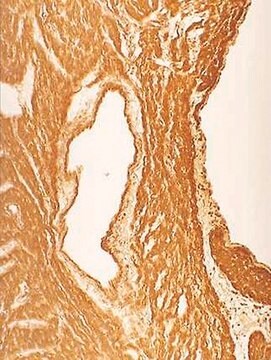
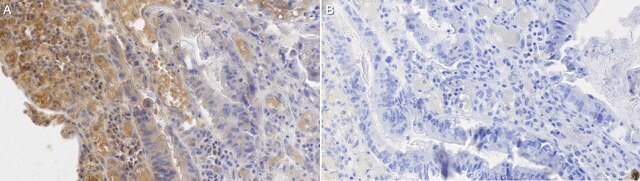
1:50-1:100 on paraffin embedded of a previous lot, 10% neutral buffer formalin fixed mouse liver (animal treated with Zymosan) and normal human cerebellum tissues. The tissues must be pretreated with heat induced epitope retrieval (HIER). Incubation with the MAB5404 was for 10 minutes and the reaction was developed with the Chemicon IHC-Select, HRP-DAB kit (Catalog number DAB150).

Optimal working dilutions must be determined by end user.
Research Category
Neuroscience
Research Sub Category
Oxidative Stress

Biochem/physiol Actions

Reacts with nitrotyrosine.

Physical form

Format: Purified
Protein A purified
Purified mouse monoclonal IgG2b liquid in buffer containing 0.1% sodium azide.

Preparation Note

Stable for 1 year at 2-8ºC from date of receipt.

Analysis Note

Control
Nitrated BSA
Evaluated by Western Blot on Nitrotyrosine Immunoblot Controls.

Western Blot Analysis:
1:500 dilution of this antibody detected Nitrotyrosine on 10 μg of Nitrotyrosine Immunoblot Controls (cat. # 12-354).

Other Notes

Concentration: Please refer to the Certificate of Analysis for the lot-specific concentration.

Legal Information

CHEMICON is a registered trademark of Merck KGaA, Darmstadt, Germany

Disclaimer

Unless otherwise stated in our catalog or other company documentation accompanying the product(s), our products are intended for research use only and are not to be used for any other purpose, which includes but is not limited to, unauthorized commercial uses, in vitro diagnostic uses, ex vivo or in vivo therapeutic uses or any type of consumption or application to humans or animals.

Not finding the right product?  

Try our Product Selector Tool.

Storage Class

12 - Non Combustible Liquids

wgk_germany

WGK 2

flash_point_f

Not applicable

flash_point_c

Not applicable


Certificates of Analysis (COA)

Search for Certificates of Analysis (COA) by entering the products Lot/Batch Number. Lot and Batch Numbers can be found on a product’s label following the words ‘Lot’ or ‘Batch’.

Already Own This Product?

Find documentation for the products that you have recently purchased in the Document Library.

Visit the Document Library

A Kiss et al.
British journal of pharmacology, 155(7), 1015-1024 (2008-10-11)
Exogenous peroxynitrite from nanomolar to micromolar concentrations exerts cardioprotection. Here, we have assessed its effects on ischaemia- and reperfusion-induced ventricular arrhythmias in vivo and a possible role for mitochondrial K(ATP) channels in these effects, using the channel inhibitor 5-hydroxydecanoate (5-HD).
Satoru Hasegawa et al.
Redox report : communications in free radical research, 22(1), 26-34 (2016-02-13)
Duchenne muscular dystrophy (DMD) is a devastating muscle disease caused by a mutation in DMD encoding dystrophin. Oxidative stress accounts for dystrophic muscle pathologies in DMD. We examined the effects of molecular hydrogen in mdx mice, a model animal for
Priyanka Chauhan et al.
Journal of neuroinflammation, 15(1), 66-66 (2018-03-07)
Peripheral neuropathy is currently the most common neurological complication in HIV-infected individuals, occurring in 35-50% of patients undergoing combination anti-retroviral therapy. Data have shown that distal symmetric polyneuropathy develops in mice by 6 weeks following infection with the LP-BM5 retrovirus mixture.
Jason Y H Chang et al.
Advanced healthcare materials, 6(16) (2017-05-18)
Nitric oxide (NO) is a free radical signaling molecule that plays a crucial role in modulating physiological homeostasis across multiple biological systems. NO dysregulation is linked to the pathogenesis of multiple diseases; therefore, its quantification is important for understanding pathophysiological
Ben C Creelan et al.
OncoTargets and therapy, 10, 4239-4250 (2017-09-19)
Omaveloxolone is a semisynthetic oleanane triterpenoid that potently activates Nrf2 with subsequent antioxidant function. We conducted a first-in-human Phase I clinical trial (NCT02029729) with the primary objectives to determine the appropriate dose for Phase II studies, characterize pharmacokinetic and pharmacodynamic

Related Content

"Aging: getting older, exhibiting the signs of age, the decline in the physical (and mental) well-being over time, leading to death. Since the beginning of time, man has been obsessed with trying to slow down, stop, or even reverse the signs of aging. Many have gone as far as experimenting with nutritional regimens, eccentric exercises, fantastic rituals, and naturally occurring or synthetic wonder-elements to evade the signs of normal aging. Biologically speaking, what is aging? And what does the latest research tell us about the possibility of discovering the elusive “fountain of youth”? Many advances in our understanding of aging have come from systematic scientific research, and perhaps it holds the key to immortality. Scientifically, aging can be defined as a systems-wide decline in organismal function that occurs over time. This decline occurs as a result of numerous events in the organism, and these events can be classified into nine “hallmarks” of aging, as proposed by López-Otin et al. (2013). Several of the pathologies associated with aging are a direct result of these events going to extremes and may also involve aberrant activation of proliferation signals or hyperactivity. The hallmarks of aging have been defined based on their fulfillment of specific aging related criteria, such as manifestation during normal aging, acceleration of aging if experimentally induced or aggravated, and retardation of aging if prevented or blocked, resulting in increased lifespan. The nine hallmarks of aging are genomic instability, telomere attrition, epigenetic alterations, loss of proteostasis, deregulated nutrient sensing, mitochondrial dysfunction, cellular senescence, stem cell exhaustion, and altered intercellular communication. The biological processes underlying aging are complex. By understanding the hallmarks in greater detail, we can get closer to developing intervention strategies that can make the aging process less of a decline, and more of a recline."

"Redox reactions are powerful chemical processes that involve the reduction and oxidation of proteins and metabolites found in living things. The mechanisms that regulate them are key to maintaining homeostasis and the balance between good health and disease pathology. Oxidative stress is the state where the delicate balance of redox biology is upset, and the pathology of oxidative stress are the cellular consequences to such an imbalance."

Our team of scientists has experience in all areas of research including Life Science, Material Science, Chemical Synthesis, Chromatography, Analytical and many others.

Contact Technical Service