Skip to Content
MilliporeSigma

IRMM315

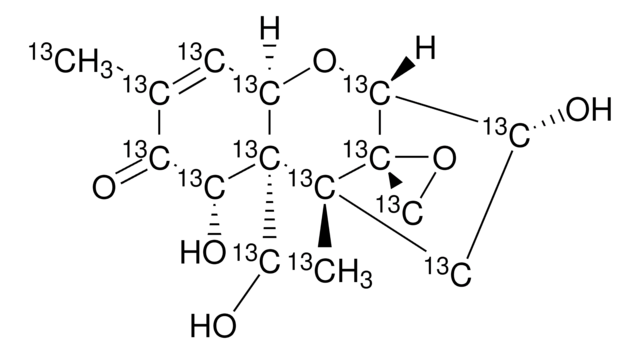
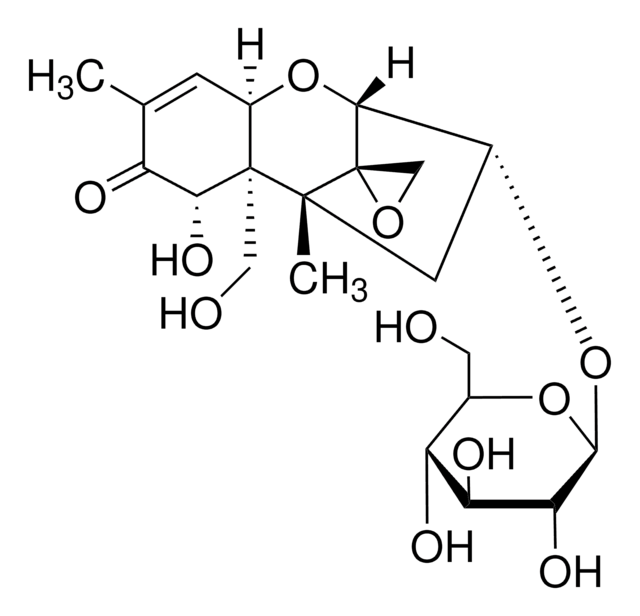
4-Deoxynivalenol in acetonitrile

IRMM®, certified reference material

Synonym(s):

Deoxynivalenol solution, 3α,7α,15-Trihydroxy-12,13-epoxytrichothec-9-en-8-one, DON, Vomitoxin

Sign In to View Organizational & Contract Pricing.

Select a Size


About This Item

Empirical Formula (Hill Notation):
C15H20O6
CAS Number:
Molecular Weight:
296.32
NACRES:
NA.24
PubChem Substance ID:
UNSPSC Code:
41116107
EC Number:
200-835-2
MDL number:
Technical Service
Need help? Our team of experienced scientists is here for you.
Let Us Assist
Technical Service
Need help? Our team of experienced scientists is here for you.
Let Us Assist

Product Name

4-Deoxynivalenol in acetonitrile, IRMM®, certified reference material

InChI key

LINOMUASTDIRTM-QGRHZQQGSA-N

InChI

1S/C15H20O6/c1-7-3-9-14(5-16,11(19)10(7)18)13(2)4-8(17)12(21-9)15(13)6-20-15/h3,8-9,11-12,16-17,19H,4-6H2,1-2H3/t8-,9-,11-,12-,13-,14-,15+/m1/s1

SMILES string

CC1=C[C@H]2O[C@@H]3[C@H](O)C[C@@](C)([C@]34CO4)[C@@]2(CO)[C@H](O)C1=O

grade

certified reference material

agency

IRMM®

manufacturer/tradename

JRC

application(s)

general analytical

format

matrix material

storage temp.

2-8°C

Looking for similar products? Visit Product Comparison Guide

Analysis Note

For more information please see:
IRMM315

General description

Legal Information

IRMM is a registered trademark of European Commission

pictograms

FlameExclamation mark

signalword

Danger

Hazard Classifications

Acute Tox. 4 Dermal - Acute Tox. 4 Inhalation - Acute Tox. 4 Oral - Eye Irrit. 2 - Flam. Liq. 2

Storage Class

3 - Flammable liquids

wgk

WGK 2

flash_point_f

35.6 °F - closed cup

flash_point_c

2.0 °C - closed cup


Certificates of Analysis (COA)

Search for Certificates of Analysis (COA) by entering the products Lot/Batch Number. Lot and Batch Numbers can be found on a product’s label following the words ‘Lot’ or ‘Batch’.

Already Own This Product?

Find documentation for the products that you have recently purchased in the Document Library.

Visit the Document Library

Amal Halawa et al.
Archives of animal nutrition, 67(2), 134-146 (2013-03-26)
Deoxynivalenol (DON) is one of the most important trichothecenes, due to its worldwide distribution and common contamination of animal feed. It mainly affects the gastrointestinal tract and the immune system with a high susceptibility for swine. Lipopolysaccharides (LPS) are endotoxins
Brenna M Flannery et al.
Toxicology, 304, 192-198 (2013-01-10)
Consumption of the trichothecene deoxynivalenol (DON) suppresses growth in experimental animals - an adverse effect that was used to establish the tolerable daily intake for this toxin. DON ingestion has been recently found to suppress plasma insulin-like growth factor acid-labile
Sven Dänicke et al.
Toxicology letters, 220(2), 172-180 (2013-04-23)
The systemic effects of the Fusarium toxin deoxynivalenol (DON) and of bacterial lipopolysaccharides (LPS) were studied in male castrated pigs (40.4 ± 3.7 kg) infused intravenously with either DON or LPS alone (100 μg DON/kg/h, 7.5 μg/LPS/kg/h), or together (100
Joelma Lucioli et al.
Toxicon : official journal of the International Society on Toxinology, 66, 31-36 (2013-02-14)
Trichothecenes induce changes in the intestinal barrier function through decreased expression of cell junction proteins and apoptosis of enterocytes. The mitogen activated protein kinases (MAPK) play an important role in the signaling pathways of cell turnover and differentiation. Using ex
Dirk Rohweder et al.
Archives of animal nutrition, 67(1), 37-47 (2013-01-23)
Fusarium infections do not only affect the grain, but also the rest of the plant, which result in contamination of plants with the mycotoxin deoxynivalenol (DON). The bioavailability of DON may be influenced by the matrix due to the differences

Our team of scientists has experience in all areas of research including Life Science, Material Science, Chemical Synthesis, Chromatography, Analytical and many others.

Contact Technical Service