Sign Into View Organizational & Contract Pricing
Select a Size
About This Item
Empirical Formula (Hill Notation):
C9H15N4O8P
CAS Number:
Molecular Weight:
338.21
EC Number:
MDL number:
UNSPSC Code:
41106305
PubChem Substance ID:
NACRES:
NA.51
Quality Level
assay
≥93%
form
powder
mol wt
338.21 g/mol
storage temp.
−20°C
SMILES string
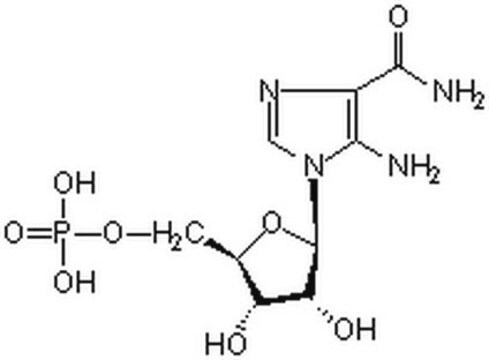
O[C@H]1[C@@H](O)[C@H](N2C=NC(C(N)=O)=C2N)O[C@@H]1COP(O)(O)=O
InChI
1S/C9H15N4O8P/c10-7-4(8(11)16)12-2-13(7)9-6(15)5(14)3(21-9)1-20-22(17,18)19/h2-3,5-6,9,14-15H,1,10H2,(H2,11,16)(H2,17,18,19)/t3-,5-,6-,9-/m1/s1
InChI key
NOTGFIUVDGNKRI-UUOKFMHZSA-N
Looking for similar products? Visit Product Comparison Guide
Related Categories
General description
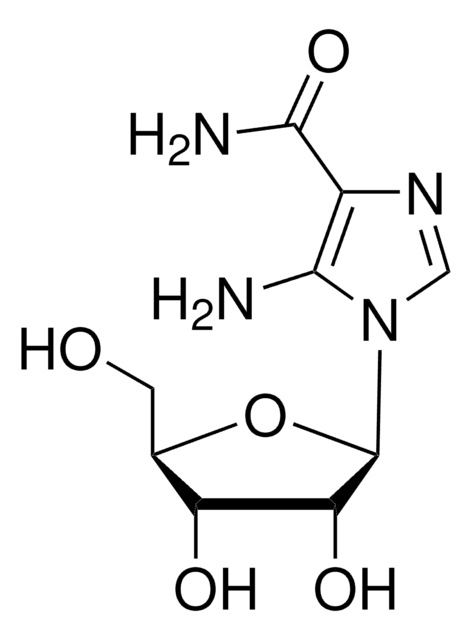
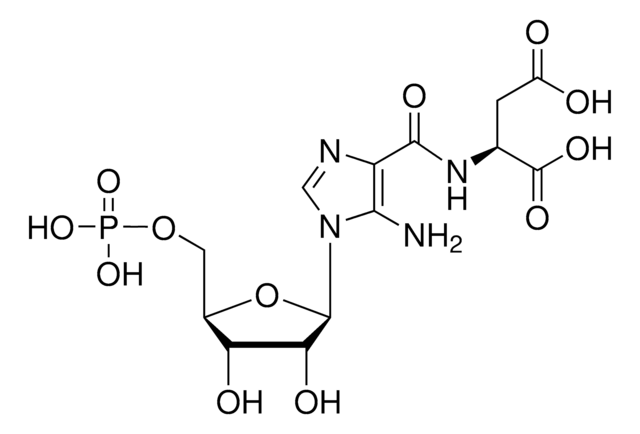
5-Aminoimidazole-4-carboxamide-1-beta-D-ribofuranosyl 5′-monophosphate (AICAR), a natural metabolic intermediate of purine biosynthesis, is usually found in all organisms. It is produced from succinyl-AICAR (SAICAR) with the help of adenylosuccinate lyase (ASL) enzyme.
Application
5-Aminoimidazole-4-carboxamide-1-β-D-ribofuranosyl 5′-monophosphate has been used in the study to explore the anticancer effect of nine statins in breast cancer and glioblastoma.
AICAR monophosphate is a 5′′-phosphorylated analog of cell permeable AICAR that mimics AMP. AICAR is an adenosine monophophate (AMP)-activated protein kinase (AMPK) activator/agonist.
Biochem/physiol Actions
A 5′-phosphorylated analog of cell permeable AICAR that mimics adenosine monophosphate (AMP). It is an AMP-activated protein kinase (AMPK) activator.
In humans, 5-Aminoimidazole-4-carboxamide-1-β-D-ribofuranosyl 5′-monophosphate (AICAR) is found to be accumulated in numerous metabolic diseases. It can increase the endurance of sedentary mice. AICAR exhibits antiproliferative effects. It can induce apoptosis of aneuploid cells.
Storage Class
11 - Combustible Solids
wgk_germany
WGK 3
flash_point_f
Not applicable
flash_point_c
Not applicable
ppe
Eyeshields, Gloves, type N95 (US)
Choose from one of the most recent versions:
Already Own This Product?
Find documentation for the products that you have recently purchased in the Document Library.
Hans P M M Lauritzen et al.
Diabetes, 62(9), 3081-3092 (2013-06-14)
Recent studies suggest that interleukin 6 (IL-6) is released from contracting skeletal muscles; however, the cellular origin, secretion kinetics, and signaling mechanisms regulating IL-6 secretion are unknown. To address these questions, we developed imaging methodology to study IL-6 in fixed
Hiroyasu Hatakeyama et al.
Molecular biology of the cell, 24(6), 809-817 (2013-01-18)
Tbc1d1 is key to skeletal muscle GLUT4 regulation. By using GLUT4 nanometry combined with a cell-based reconstitution model, we uncover a shift in the regulatory mode of Tbc1d1 by showing that Tbc1d1 temporally acquires insulin responsiveness, which triggers GLUT4 trafficking
Melissa M Thomas et al.
FASEB journal : official publication of the Federation of American Societies for Experimental Biology, 28(5), 2098-2107 (2014-02-14)
AMP-activated protein kinase (AMPK) is a master regulator of metabolism. While muscle-specific AMPK β1β2 double-knockout (β1β2M-KO) mice display alterations in metabolic and mitochondrial capacity, their severe exercise intolerance suggested a secondary contributor to the observed phenotype. We find that tibialis
Janine Dokas et al.
Endocrinology, 154(10), 3502-3514 (2013-07-31)
In the obesity-resistant SJL mouse strain, we previously identified a naturally occurring loss-of-function mutation in the gene for Tbc1d1. Characterization of recombinant inbred mice that carried the Tbc1d1(SJL) allele on a C57BL/6J background indicated that loss of TBC1D1 protects from
5-Aminoimidazole-4-carboxamide-1-beta-D-ribofuranosyl 5'-monophosphate (AICAR), a highly conserved purine intermediate with multiple effects
Daignan-Fornier B and Pinson B
Metabolites, 2(2), 292-302 (2012)
Our team of scientists has experience in all areas of research including Life Science, Material Science, Chemical Synthesis, Chromatography, Analytical and many others.
Contact Technical Service