B1439
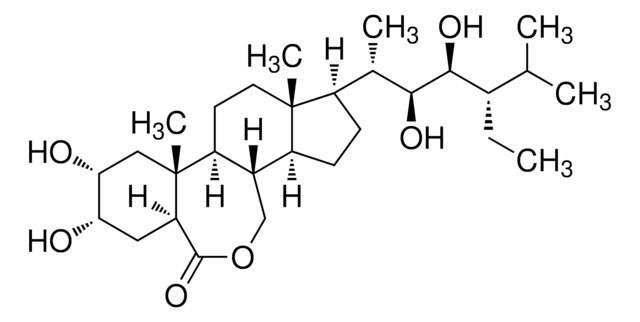
Brassinolide
≥80% (TLC)
Synonym(s):
(1R,3aS,3bS,6aS,8S,9R,10aR,10bS,12aS)-1-[(1S,2R,3R,4S)-2,3-Dihydroxy-1,4,5-trimethylhexyl]hexadecahydro-8,9-dihydroxy-10a,12a-dimethyl-6H-benz[c]indeno[5,4-e]oxepin-6-one, (2a,3a,5a,22R,23R,24S)-2,3,22,23-Tetrahydroxy-B-homo-7-oxaergostan-6-one
Sign Into View Organizational & Contract Pricing
Select a Size
About This Item
Empirical Formula (Hill Notation):
C28H48O6
Molecular Weight:
480.68
UNSPSC Code:
10171502
NACRES:
NA.25
Related Categories
General description
Brassinolide is a plant growth hormone and the most biologically active brassinosteroid (BR). It has been implicated in Auxin signaling. It has also been used for studying plant biosynthetic pathways. Brassinolide might also regulate water-transport properties of cell membranes in Arabidopsis thaliana.
Application
Brassinolide has been used as a plant growth hormone.
Biochem/physiol Actions
Brassinolide is a plant growth hormone that has been implicated in Auxin signaling. It has also been used for studying plant biosynthetic pathways.
Storage Class
11 - Combustible Solids
wgk_germany
WGK 3
flash_point_f
Not applicable
flash_point_c
Not applicable
Choose from one of the most recent versions:
Already Own This Product?
Find documentation for the products that you have recently purchased in the Document Library.
Lenka Tůmová et al.
PloS one, 13(5), e0197870-e0197870 (2018-05-26)
The contents of endogenous brassinosteroids (BRs) together with various aspects of plant morphology, water management, photosynthesis and protection against cell damage were assessed in two maize genotypes that differed in their drought sensitivity. The presence of 28-norbrassinolide in rather high
Chang-Jie Jiang et al.
Frontiers in plant science, 8, 1558-1558 (2017-09-22)
In response to pathogen attack, plants prioritize defense reactions generally at the expense of plant growth. In this work, we report that changes in phytohormone signaling pathways are associated with the stunted plant growth caused by blast disease in rice
Seonghoe Jang et al.
Plant physiology, 173(1), 688-702 (2016-11-24)
Rice atypical HLH protein Oryza sativa BRASSINOSTEROID UPREGULATED 1-LIKE1 (OsBUL1) is preferentially expressed in the lamina joint where it controls cell elongation and positively affects leaf angles. OsBUL1 knockout mutant (osbul1) and transgenic rice for double-stranded RNA interference (dsRNAi) of
Ya Pu et al.
BMC genomics, 21(1), 728-728 (2020-10-22)
The ray floret shapes referred to as petal types on the chrysanthemum (Chrysanthemum × morifolium Ramat.) capitulum is extremely abundant, which is one of the most important ornamental traits of chrysanthemum. However, the regulatory mechanisms of different ray floret shapes
Biosynthetic pathways of brassinolide in Arabidopsis.
Noguchi T, et al.
Plant Physiology, 124(1), 201-210 (2000)
Our team of scientists has experience in all areas of research including Life Science, Material Science, Chemical Synthesis, Chromatography, Analytical and many others.
Contact Technical Service