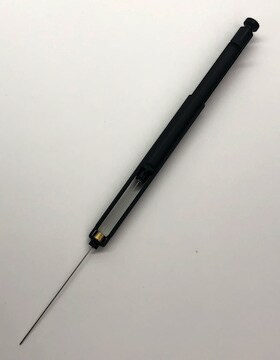
Sign In to View Organizational & Contract Pricing
Select a Size
About This Item
UNSPSC Code:
41115854
NACRES:
NB.21
material
black hub
fused silica fiber
Quality Level
needle size
23 ga
packaging
pk of 3
greener alternative product characteristics
Waste Prevention
Safer Solvents and Auxiliaries
Learn more about the Principles of Green Chemistry.
sustainability
Greener Alternative Product
df
75 μm (CAR/PDMS)
technique(s)
solid phase microextraction (SPME): suitable
fiber L
1 cm
matrix active group
CAR/PDMS coating
application(s)
food and beverages
compatibility
(For gasses and low molecular weight compounds (MW 30 - 225).)
Manual Holder
greener alternative category
Looking for similar products? Visit Product Comparison Guide
General description
For Gases and Low Molecular Weight Compounds (MW 30-225)
We are committed to bringing you greener alternative products, which adhere to one or more of The 12 Principles of Greener Chemistry. This is a Solid Phase Microextraction (SPME) technology product. SPME is one of the greener technologies for sample preparation as it is solvent free extraction technology and SPME fibres are re-usable and generates as little waste as possible, thus aligns with "Waste Prevention”, and ″Safer Solvents and Auxiliaries″. Click here for more information.
Application
- Evaluation of a multi-fiber exchange solid-phase microextraction system and its application to on-site sampling: This study introduces a multi-fiber exchange system for solid-phase microextraction, specifically showcasing the efficiency of the Carboxen/Polydimethylsiloxane (CAR/PDMS) fibers in on-site sampling scenarios. The application emphasizes rapid and adaptable sampling methods that cater to dynamic environmental and laboratory conditions, enhancing both the practicality and scope of SPME′s utility in the field (Gómez-Ríos GA, Reyes-Garcés N, Pawliszyn J, 2015).
Other Notes
This SPME fiber assembly is also available with a Nitinol (NIT) core as Cat. No. 57901-U, providing enhanced fiber reproducibility, greater fiber durability, maintained selectivity for method consistency, and core inertness to ensure analyte stability. See more at SigmaAldrich.com/NITSPME .
Choose from one of the most recent versions:
Already Own This Product?
Find documentation for the products that you have recently purchased in the Document Library.
T R Dubie et al.
Journal of medical entomology, 54(5), 1299-1304 (2017-04-12)
Commercial livestock facilities are faced with the challenge of managing large amounts of waste including manure and animal mortalities. One method of disposing of dead animals is composting. The cadavers are enveloped in carbon material that creates a barrier between
Jérémy Ratel et al.
Journal of chromatography. A, 1216(45), 7889-7898 (2009-09-29)
Animal-derived products are particularly vulnerable to contamination by volatile organic compounds (VOCs). These lipophilic substances, which are generated by an increasing number of sources, are easily transferred to the atmosphere, water, soil, and plants. They are ingested by livestock and
E Serrano et al.
Journal of chromatography. A, 1216(1), 127-133 (2008-11-29)
The objective of this paper is to investigate the potential of multiple headspace-solid-phase microextraction (MHS-SPME) for the determination of volatile compounds in complex matrix samples. A method based on MHS-SPME for the determination of around 20 volatile compounds, responsible of
Carlo Bicchi et al.
Journal of chromatography. A, 1218(6), 753-762 (2011-01-05)
The study compares standard addition (SA), stable isotope dilution assay (SIDA) and multiple headspace extraction (MHE) as methods to quantify furan and 2-methyl-furan in roasted coffee with HS-SPME-GC-MS, using CAR-PDMS as fibre coating, d(4)-furan as internal standard and in-fibre internal
Sudhir Kumar Pandey et al.
Journal of chromatography. A, 1216(28), 5436-5444 (2009-06-06)
In this study, the feasibility of GC-MS was evaluated for the quantification of odorous volatile organic compounds (VOCs) in environmental samples. These included methyl ethyl ketone, isobutyl alcohol, methyl isobutyl ketone, and butyl acetate plus benzene, toluene, and xylene (BTX).
Related Content
Our team of scientists has experience in all areas of research including Life Science, Material Science, Chemical Synthesis, Chromatography, Analytical and many others.
Contact Technical Service