107131
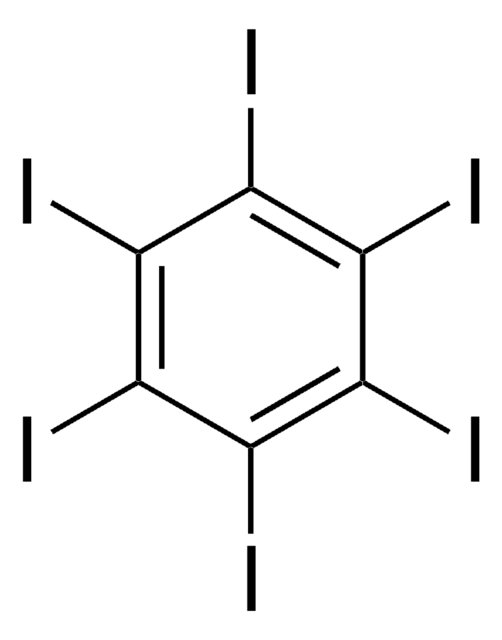
Hexabromobenzene
98%
Sign Into View Organizational & Contract Pricing
Select a Size
About This Item
Empirical Formula (Hill Notation):
C6Br6
CAS Number:
Molecular Weight:
551.49
Beilstein/REAXYS Number:
1912586
EC Number:
MDL number:
UNSPSC Code:
12352100
PubChem Substance ID:
NACRES:
NA.22
Quality Level
assay
98%
form
solid
mp
>300 °C (lit.)
solubility
chloroform: soluble 10 mg/mL
functional group
bromo
SMILES string
Brc1c(Br)c(Br)c(Br)c(Br)c1Br
InChI
1S/C6Br6/c7-1-2(8)4(10)6(12)5(11)3(1)9
InChI key
CAYGQBVSOZLICD-UHFFFAOYSA-N
Looking for similar products? Visit Product Comparison Guide
Related Categories
General description
Hexabromobenzene is used as fire retardant in plastics, paper and electric manufactured goods. It undergoes protodebromination when treated with sodium methoxide in methanol and ethyl methyl ketone to give a mixture of tetrabromobenzenes.
Application
The porphyrinogenic potential of hexabromobenzene (HBB) with hexachlorobenzene was studied in the liver of primiparous rats.
signalword
Warning
Hazard Classifications
Acute Tox. 4 Dermal - Acute Tox. 4 Inhalation - Acute Tox. 4 Oral - Aquatic Chronic 4 - Eye Irrit. 2 - Skin Irrit. 2 - STOT SE 3
target_organs
Respiratory system
Storage Class
11 - Combustible Solids
wgk_germany
WGK 3
flash_point_f
Not applicable
flash_point_c
Not applicable
Choose from one of the most recent versions:
Already Own This Product?
Find documentation for the products that you have recently purchased in the Document Library.
Polyhalogeno-aromatic compounds. Part VIII. Reactions of hexabromobenzene with nucleophiles.
Collins I and Suschitzky H.
J. Chem. Soc. Sect. C, 18, 2337-2341 (1969)
Uptake of chloro- and bromobiphenyls, hexachloro- and hexabromobenzene by fish.
V Zitko et al.
Bulletin of environmental contamination and toxicology, 16(6), 665-673 (1976-12-01)
Comparison of the porphyrinogenic activity of hexabromobenzene and hexachlorobenzene in primiparous Wistar rats.
C E Mendoza et al.
Bulletin of environmental contamination and toxicology, 21(3), 358-364 (1979-02-01)
A G Smith et al.
Research communications in chemical pathology and pharmacology, 28(2), 377-384 (1980-05-01)
Virgin female Agus rats were fed a diet containing hexahalogenated benzenes (700 nmol/g of food) for 70 days. The liver concentrations of these compounds were then determined and correlated with any depression in uroporphyrinogen decarboxylase activity and increases in porphyrin
Joanna Wencel-Delord et al.
Angewandte Chemie (International ed. in English), 51(52), 13001-13005 (2012-10-23)
C(6)Br(six) & drugs! C(6)Br(6) can be used as the cooxidant/catalyst modifier for the [Rh(III)Cp*]-catalyzed (Cp*=C(5)Me(5)) dehydrogenative cross-coupling of benzamides with simple benzene derivatives (see scheme, DG=directing group). Similarly, heterocycles can be coupled and druglike structures formed. Mechanistic studies suggest a
Our team of scientists has experience in all areas of research including Life Science, Material Science, Chemical Synthesis, Chromatography, Analytical and many others.
Contact Technical Service