Sign In to View Organizational & Contract Pricing.
Select a Size
About This Item
Linear Formula:
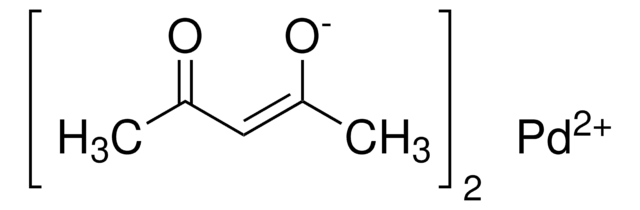
Pd(OCOCH3)2
CAS Number:
Molecular Weight:
224.51
Beilstein/REAXYS Number:
6086766
EC Number:
MDL number:
UNSPSC Code:
12352103
PubChem Substance ID:
NACRES:
NA.23
Quality Level
assay
99.98% trace metals basis
form
powder
reaction suitability
core: palladium
reagent type: catalyst
mp
216.3-223.7 °C (dec.)
SMILES string
CC(O[Pd]OC(C)=O)=O
InChI
1S/2C2H4O2.Pd/c2*1-2(3)4;/h2*1H3,(H,3,4);/q;;+2/p-2
InChI key
YJVFFLUZDVXJQI-UHFFFAOYSA-L
Looking for similar products? Visit Product Comparison Guide
General description
Palladium(II) acetate is an orange, brown, moderately water-soluble source of palladium. We provide palladium(II) acetate with a purity of 99.98% on a trace metals basis (< 250.0 ppm), making it ideal for a wide range of catalytic reactions.
Application
Palladium(II) acetate is used
- As a precursor in the one-step solvothermal synthesis of carbon-supported PtPdCu nanoalloy catalysts, enabling the formation of uniform nanoparticles with enhanced catalytic activity and stability for fuel cell applications.
- As a key catalyst in the Sonogashira–Hagihara cross-coupling reaction to synthesize microporous polymers, which are carbonized to produce high-performance porous carbon electrodes for supercapacitors and hydrogen evolution reactions.
- As a precursor in the fabrication of metallic nanopatterns through focused ion beam-induced decomposition of spin-coated thin films, enabling the creation of conductive palladium nanostructures for applications in nanoelectronics and advanced lithography.
Features and Benefits
- High palladium loading (46.2 - 48.6%) increases the availability of active sites for catalysis, leading to more efficient conversion of reactants into products as more palladium atoms are involved in the reaction.
- Ultra-high purity (99.98% Trace Metals Basis) minimizes contamination, enhancing performance by reducing metal sintering, preventing irreversible reactions with catalytic species, and maintaining optimal electronic properties for better catalyst efficiency in palladium-sensitive applications.
signalword
Danger
hcodes
Hazard Classifications
Aquatic Acute 1 - Aquatic Chronic 1 - Eye Dam. 1 - Skin Sens. 1A
Storage Class
11 - Combustible Solids
wgk_germany
WGK 2
flash_point_f
Not applicable
flash_point_c
Not applicable
ppe
dust mask type N95 (US), Eyeshields, Gloves
Choose from one of the most recent versions:
Already Own This Product?
Find documentation for the products that you have recently purchased in the Document Library.
Xu, J.; et al.
Journal of Nanoparticle Research, 7 (4-5), 449-467 (2005)
Jujjuri, S.; et al.
J. Catal., 239 (2), 486-500 (2006)
Upendra Sharma et al.
Angewandte Chemie (International ed. in English), 53(44), 11895-11899 (2014-09-11)
A palladium-catalyzed dehydrogenative coupling between diarylamines and olefins has been discovered for the synthesis of substituted indoles. This intermolecular annulation approach incorporates readily available olefins for the first time and obviates the need of any additional directing group. An ortho palladation
Hu Kang et al.
Journal of the American Chemical Society, 128(18), 6194-6205 (2006-05-04)
A novel type of "X-shaped" two-dimensional electro-optic (EO) chromophore with extended conjugation has been synthesized and characterized. This chromophore is found to exhibit a remarkably blue-shifted optical maximum (357 nm in CH(2)Cl(2)) while maintaining a very large first hyperpolarizability (beta).
Palladium-catalyzed synthesis of benzofurans and coumarins from phenols and olefins.
Upendra Sharma et al.
Angewandte Chemie (International ed. in English), 52(48), 12669-12673 (2013-10-16)
Our team of scientists has experience in all areas of research including Life Science, Material Science, Chemical Synthesis, Chromatography, Analytical and many others.
Contact Technical Service