Sign Into View Organizational & Contract Pricing
Select a Size
About This Item
Linear Formula:
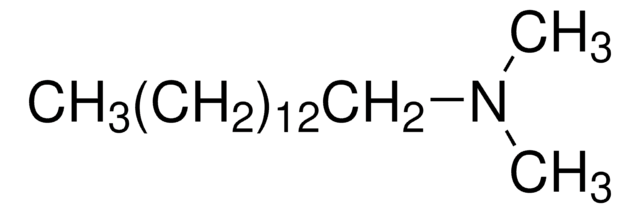
CH3(CH2)15N(CH3)2
CAS Number:
Molecular Weight:
269.51
Beilstein/REAXYS Number:
1755921
EC Number:
MDL number:
UNSPSC Code:
12352100
PubChem Substance ID:
NACRES:
NA.22
grade
technical
Quality Level
assay
≥95% (GC)
≥98.0% (NT)
impurities
≤0.3% water
density
0.801 g/mL at 20 °C (lit.)
functional group
amine
SMILES string
CCCCCCCCCCCCCCCCN(C)C
InChI
1S/C18H39N/c1-4-5-6-7-8-9-10-11-12-13-14-15-16-17-18-19(2)3/h4-18H2,1-3H3
Inchi Key
NHLUVTZJQOJKCC-UHFFFAOYSA-N
Related Categories
General description
N,N-Dimethylhexadecylamine is a swelling agent useful for the enlargement of the size of mesopores of colloidal silica nanoparticles.
Application
N,N-Dimethylhexadecylamine may be employed in the following studies:
- As pore size mediator for the synthesis of monodispersed mesoporous silica nanoparticles.
- As swelling agent in the fabrication of colloidal mesoporous silica nanoparticles of a tunable mesopore size.
- Preparation of 1,4-bis(N-hexadecyl-N,N-dimethylammonium)butane dibromide, Gemini surfactant.
signalword
Danger
hcodes
Hazard Classifications
Acute Tox. 4 Oral - Aquatic Acute 1 - Aquatic Chronic 1 - Eye Dam. 1 - Skin Corr. 1B
Storage Class
8A - Combustible corrosive hazardous materials
wgk_germany
WGK 3
flash_point_f
287.6 °F - closed cup
flash_point_c
142 °C - closed cup
ppe
Faceshields, Gloves, Goggles, type ABEK (EN14387) respirator filter
Choose from one of the most recent versions:
Already Own This Product?
Find documentation for the products that you have recently purchased in the Document Library.
Amani L Lee et al.
ACS nano, 11(6), 5623-5632 (2017-05-16)
Oxygen homeostasis is important in the regulation of biological function. Disease progression can be monitored by measuring oxygen levels, thus producing information for the design of therapeutic treatments. Noninvasive measurements of tissue oxygenation require the development of tools with minimal
Ramiro Martínez-Cámara et al.
Folia microbiologica, 65(3), 523-532 (2019-12-14)
Bacteria have developed different intra- and inter-specific communication mechanisms that involve the production, release, and detection of signaling molecules, because these molecules serve as the autoinducers involved in "quorum sensing" systems. Other communication mechanisms employ volatile signaling molecules that regulate
Ernesto Vázquez-Chimalhua et al.
Protoplasma, 256(3), 643-654 (2018-11-02)
Chemical communication underlies major adaptive traits in plants and shapes the root microbiome. An increasing number of diffusible and/or volatile organic compounds released by bacteria have been identified, which play phytostimulant or protective functions, including dimethyl-hexa-decylamine (DMHDA), a volatile biosynthesized
Shanshan Dai et al.
Physical chemistry chemical physics : PCCP, 20(16), 11285-11295 (2018-04-11)
A series of CO2-responsive oil-in-water (O/W) emulsions were prepared by introducing hydrophobic tertiary amines (TAs) with varying alkane carbon numbers (ACNs) into the emulsion stabilized by sodium dodecyl benzene sulfonate (SDBS). TAs are converted to bicarbonate salts upon bubbling of
Jinlou Gu et al.
Journal of colloid and interface science, 407, 236-242 (2013-07-20)
Despite their great potentials as biomacromolecues delivery vehicles, there are few, if any, reports on mesoporous silica nanoparticles (MSNs) simultaneously integrated with the merits of large pore size, small particle diameters and well-ordered mesostructure. Here, we designed a facile strategy
Our team of scientists has experience in all areas of research including Life Science, Material Science, Chemical Synthesis, Chromatography, Analytical and many others.
Contact Technical Service