Skip to Content
MilliporeSigma

586765

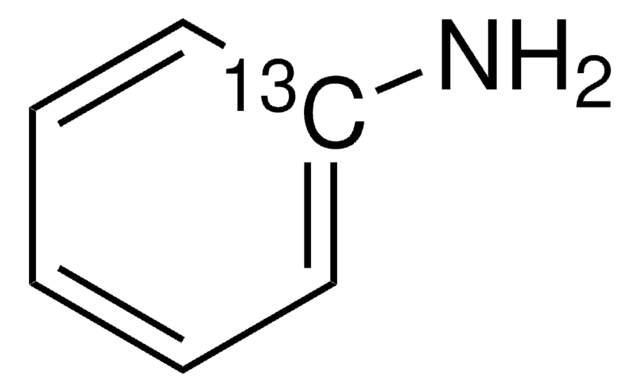
Aniline-4-13C

99 atom % 13C

Synonym(s):

Benzenamine-4-13C

Sign Into View Organizational & Contract Pricing

About This Item

Linear Formula:
13CC5H4NH2
CAS Number:
Molecular Weight:
93.11
MDL number:
UNSPSC Code:
12352005
PubChem Substance ID:
Technical Service
Need help? Our team of experienced scientists is here for you.
Let Us Assist

isotopic purity

99 atom % 13C

bp

184 °C (lit.)

mp

-6 °C (lit.)

density

1.033 g/mL at 25 °C

mass shift

M+1

storage temp.

2-8°C

SMILES string

Nc1cc[13cH]cc1

InChI

1S/C6H7N/c7-6-4-2-1-3-5-6/h1-5H,7H2/i1+1

InChI key

PAYRUJLWNCNPSJ-OUBTZVSYSA-N

General description

Aniline-4-13C 99 atom % 13C is a high-purity isotope product with a unique chemical profile that belongs to the class of isotopes. Produced by Sigma-Aldrich, we are committed to providing quality isotope products and a reliable supply chain. Available in industrial and pre-pack quantities.

Application

- High-resolution NMR spectroscopy
- Metabolomic profiling and pathway analysis
- Stable Isotope probing in Environmental microbiology
- reaction mechanism investigations

Features and Benefits

Features
  • Cutting-edge technology in production.
  • Comprehensive support and documentation provided.
  • Flexible ordering options for different scales.
  • Expert technical assistance available.


Benefits
  • Streamlines the synthesis of complex molecules.
  • Supports innovative approaches in organic chemistry.
  • Enhances the efficiency of chemical reactions.
  • Facilitates the development of new therapeutic agents.

Packaging

This product may be available from bulk stock and can be packaged on demand. For information on pricing, availability and packaging, please contact Stable Isotopes Customer Service.

signalword

Danger

Hazard Classifications

Acute Tox. 3 Dermal - Acute Tox. 3 Inhalation - Acute Tox. 3 Oral - Aquatic Acute 1 - Aquatic Chronic 1 - Carc. 2 - Eye Dam. 1 - Muta. 2 - Resp. Sens. 1

Storage Class

6.1A - Combustible acute toxic Cat. 1 and 2 / very toxic hazardous materials

wgk_germany

WGK 3

flash_point_f

168.8 °F - closed cup

flash_point_c

76 °C - closed cup


Choose from one of the most recent versions:

Certificates of Analysis (COA)

Lot/Batch Number

It looks like we've run into a problem, but you can still download Certificates of Analysis from our Documents section.

If you need assistance, please contact Customer Support

Already Own This Product?

Find documentation for the products that you have recently purchased in the Document Library.

Visit the Document Library

Ronald Besandre et al.
Organic letters, 15(7), 1666-1669 (2013-03-15)
N-substituted indoles are synthesized from primary amines through a tandem reaction sequence. Initial condensation of the amine with an α-(o-haloaryl)ketone or aldehyde is followed by intramolecular aryl amination catalyzed by CuI. A variety of anilines and alkyl amines, including those
Timo Stahl et al.
Journal of the American Chemical Society, 135(4), 1248-1251 (2013-01-15)
Heterolytic splitting of the Si-H bond mediated by a Ru-S bond forms a sulfur-stabilized silicon cation that is sufficiently electrophilic to abstract fluoride from CF(3) groups attached to selected anilines. The ability of the Ru-H complex, generated in the cooperative
Roman Spesyvtsev et al.
Faraday discussions, 157, 165-179 (2012-12-13)
Femtosecond time-resolved photoelectron imaging is employed to investigate ultrafast electronic relaxation in aniline, a prototypical aromatic amine. The molecule is excited at wavelengths between 269 and 238 nm. We observe that the S2(pi3s/pi sigma*) state is populated directly during the
Yu Qian et al.
Chemical communications (Cambridge, England), 49(26), 2700-2702 (2013-02-26)
An enantioselective four-component reaction of a diazoketone, water, an aniline and ethyl glyoxylate in the presence of catalytic Rh2(OAc)4 and a chiral Brønsted acid was developed to efficiently produce β-hydroxy-α-amino acid derivatives in good yields with high diastereoselectivity and enantioselectivity.
Laya Siroos Rezaei et al.
Environmental technology, 33(19-21), 2273-2280 (2013-02-12)
Aerobic granules can be formed in sequencing batch airlift reactors (SBAR) and sequencing batch reactors (SBR). Comparing these two systems, the SBAR has excellent mixing condition, but due to a high height-to-diameter ratio (H/D), there is no performance capability at

Our team of scientists has experience in all areas of research including Life Science, Material Science, Chemical Synthesis, Chromatography, Analytical and many others.

Contact Technical Service