
W259525

β-Ionone
natural, ≥95%, FG
Synonym(s):
4-(2,6,6-Trimethyl-1-cyclohexenyl)-3-buten-2-one
About This Item
Halal
Kosher
natural
Recommended Products


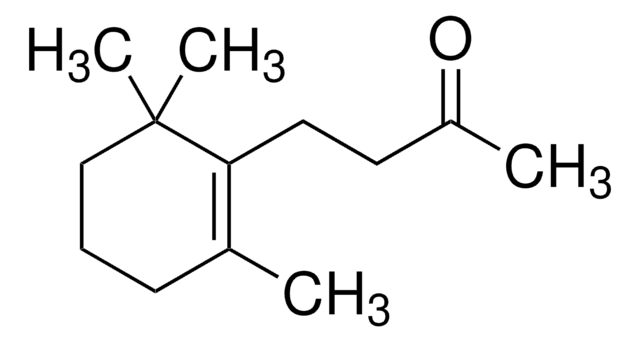


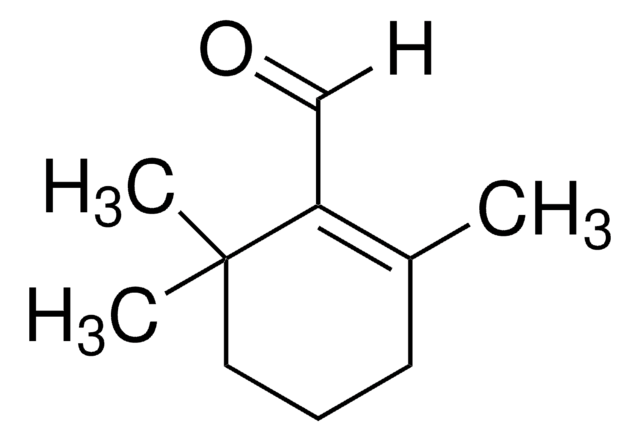


grade
FG
Halal
Kosher
natural
reg. compliance
EU Regulation 1334/2008 & 178/2002
FDA 21 CFR 117
assay
≥95%
refractive index
n20/D 1.52 (lit.)
bp
126-128 °C/12 mmHg (lit.)
density
0.945 g/mL at 25 °C (lit.)
application(s)
flavors and fragrances
documentation
see Safety & Documentation for available documents
food allergen
no known allergens
organoleptic
berry; floral; woody; sweet
SMILES string
CC(=O)\C=C\C1=C(C)CCCC1(C)C
InChI
1S/C13H20O/c1-10-6-5-9-13(3,4)12(10)8-7-11(2)14/h7-8H,5-6,9H2,1-4H3/b8-7+
InChI key
PSQYTAPXSHCGMF-BQYQJAHWSA-N
Looking for similar products? Visit Product Comparison Guide
General description
Other Notes


signalword
Warning
hcodes
Hazard Classifications
Aquatic Chronic 2 - Skin Irrit. 2
Storage Class
10 - Combustible liquids
wgk_germany
WGK 2
Choose from one of the most recent versions:
Already Own This Product?
Find documentation for the products that you have recently purchased in the Document Library.
Customers Also Viewed


Our team of scientists has experience in all areas of research including Life Science, Material Science, Chemical Synthesis, Chromatography, Analytical and many others.
Contact Technical Service