Skip to Content
MilliporeSigma

95320

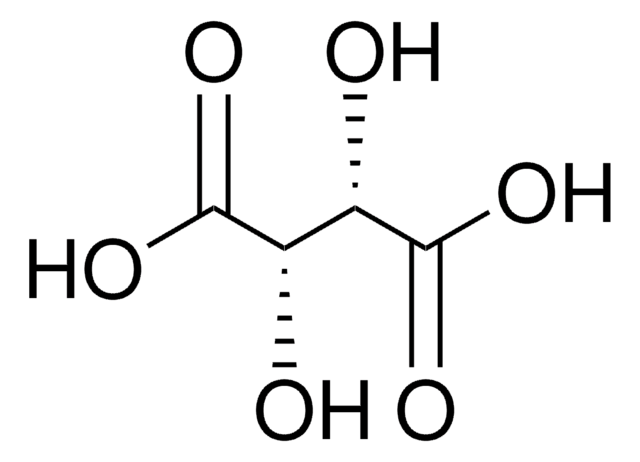
D-(−)-Tartaric acid

puriss., unnatural form, ≥99.0% (T)

Synonym(s):

(2S,3S)-(−)-Tartaric acid, D-Threaric acid

Sign In to View Organizational & Contract Pricing.

Select a Size


About This Item

Linear Formula:
HO2CCH(OH)CH(OH)CO2H
CAS Number:
Molecular Weight:
150.09
UNSPSC Code:
51113400
NACRES:
NA.22
PubChem Substance ID:
EC Number:
205-695-6
Beilstein/REAXYS Number:
1725145
MDL number:
Assay:
≥99.0% (T)
Form:
crystals
Technical Service
Need help? Our team of experienced scientists is here for you.
Let Us Assist
Technical Service
Need help? Our team of experienced scientists is here for you.
Let Us Assist

Product Name

D-(−)-Tartaric acid, puriss., unnatural form, ≥99.0% (T)

InChI key

FEWJPZIEWOKRBE-LWMBPPNESA-N

InChI

1S/C4H6O6/c5-1(3(7)8)2(6)4(9)10/h1-2,5-6H,(H,7,8)(H,9,10)/t1-,2-/m0/s1

SMILES string

O[C@@H]([C@H](O)C(O)=O)C(O)=O

description

synthetic

grade

puriss.

assay

≥99.0% (T)

form

crystals

optical activity

[α]20/D −13.5±0.5°, c = 10% in H2O

quality

unnatural form

ign. residue

≤0.05%

mp

167-171 °C
172-174 °C (lit.)

functional group

carboxylic acid
hydroxyl

Quality Level

Looking for similar products? Visit Product Comparison Guide

Application

D-(-)-Tartaric acid may be used in the preparation of enantiospecific homochiral cis-4-formyl β-lactams. It may also be used as a starting material in the synthesis of D-erythro-sphingosine and L-lyxo-phytosphingosine.

General description

Tartaric acid is a polyhydroxy acid with wide applications in the textile, pharma, and food industries. It is commonly used as a food additive and acts as an antioxidant and acidification agent. It is also used as a starting material for the preparation of many bioactive molecules.

Other Notes

Unnatural isomer

pictograms

Corrosion

signalword

Danger

hcodes

Hazard Classifications

Eye Dam. 1

Storage Class

11 - Combustible Solids

wgk

WGK 3

ppe

dust mask type N95 (US), Eyeshields, Gloves


Choose from one of the most recent versions:

Certificates of Analysis (COA)

Lot/Batch Number

Don't see the Right Version?

If you require a particular version, you can look up a specific certificate by the Lot or Batch number.

Already Own This Product?

Find documentation for the products that you have recently purchased in the Document Library.

Visit the Document Library

The energy-saving production of tartaric acid using ion exchange resin-filling bipolar membrane electrodialysis
Zhang K, et al.
Journal of Membrane Science , 341(1-2), 246-251 (2009)
Tartaric acid and tartrates in the synthesis of bioactive molecules
Ghosh AK, et al.
Synthesis, 2001(09), 1281-1301 (2001)
Efficient Asymmetric Synthesis of cis-4-Formyl-?-Lactams from L-(+)-Tartaric Acid.
Jayaraman M, et al.
The Journal of Organic Chemistry, 59(4), 932-934 (1994)
An alternative synthesis of d-erythro-sphingosine and l-lyxo-phytosphingosine.
Nakamura T and Shiozaki M.
Tetrahedron Letters, 40(51), 9063-9064 (1999)
Andrea Bencini et al.
Chemical communications (Cambridge, England), 48(84), 10428-10430 (2012-09-18)
A chiral ditopic polyammonium receptor featuring two [9]aneN(3) moieties separated by a (S)-BINOL linker is able to selectively bind and sense in water (S,S)-tartaric acid over its (R,R)/meso forms.

Our team of scientists has experience in all areas of research including Life Science, Material Science, Chemical Synthesis, Chromatography, Analytical and many others.

Contact Technical Service