Sign In to View Organizational & Contract Pricing.
Select a Size
Change View
About This Item
Empirical Formula (Hill Notation):
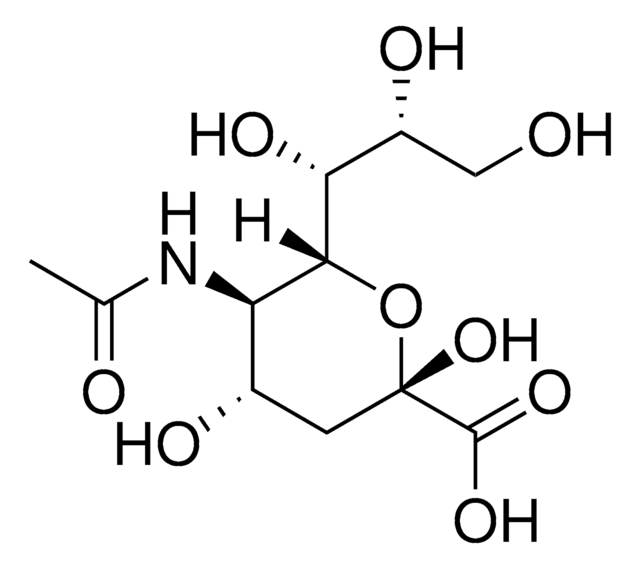
C11H19NO10
CAS Number:
Molecular Weight:
325.27
PubChem Substance ID:
UNSPSC Code:
12352201
Beilstein/REAXYS Number:
1716828
MDL number:
biological source
synthetic
Quality Level
assay
≥95% (HPLC)
form
powder
storage temp.
−20°C
SMILES string
[H][C@]1(O[C@@](O)(C[C@H](O)[C@H]1NC(=O)CO)C(O)=O)[C@H](O)[C@H](O)CO
InChI
1S/C11H19NO10/c13-2-5(16)8(18)9-7(12-6(17)3-14)4(15)1-11(21,22-9)10(19)20/h4-5,7-9,13-16,18,21H,1-3H2,(H,12,17)(H,19,20)/t4-,5+,7+,8+,9+,11-/m0/s1
InChI key
FDJKUWYYUZCUJX-AJKRCSPLSA-N
Application
Glycolylneuraminic acid, a component of non-human milk and colostrums, is used as a reference to analyse changes of the glycome during lactation. Glycolylneuraminic acid, a xenoantigen, is involved in antigenic reactions (antibody-mediated hyperacute rejection) during xenotransplantion.
Other Notes
Regulation of N-glycolylneuraminic acid biosynthesis in rat and mouse liver
Sales restrictions may apply
To gain a comprehensive understanding of our extensive range of Monosaccharides for your research, we encourage you to visit our Carbohydrates Category page.
Still not finding the right product?
Explore all of our products under N-Glycolylneuraminic acid
Storage Class
11 - Combustible Solids
wgk
WGK 3
flash_point_f
Not applicable
flash_point_c
Not applicable
ppe
Eyeshields, Gloves, type N95 (US)
Choose from one of the most recent versions:
Already Own This Product?
Find documentation for the products that you have recently purchased in the Document Library.
A Lepers et al.
European journal of biochemistry, 193(3), 715-723 (1990-11-13)
The relative contribution of N-glycoloyl-beta-D-neuraminic acid (Neu5Gc) to total sialic acids expressed in mouse and rat liver glycoconjugates was found to be 95% and 11%, respectively. This considerable difference in sialic acid composition made these two tissues suitable models for
Jonas Löfling et al.
Virology, 440(1), 89-96 (2013-03-19)
Feline panleukopenia virus (FPV) is a pathogen whose canine-adapted form (canine parvovirus (CPV)) emerged in 1978. These viruses infect by binding host transferrin receptor type-1 (TfR), but also hemagglutinate erythrocytes. We show that hemagglutination involves selective recognition of the non-human
Alexandra S Gambaryan et al.
Journal of virology, 86(8), 4370-4379 (2012-02-22)
Influenza viruses of gallinaceous poultry and wild aquatic birds usually have distinguishable receptor-binding properties. Here we used a panel of synthetic sialylglycopolymers and solid-phase receptor-binding assays to characterize receptor-binding profiles of about 70 H7 influenza viruses isolated from aquatic birds