Sign Into View Organizational & Contract Pricing
Select a Size
About This Item
UNSPSC Code:
12352203
NACRES:
NA.46
biological source
mouse
Quality Level
conjugate
unconjugated
antibody form
ascites fluid
antibody product type
secondary antibodies
clone
GT-34, monoclonal
contains
15 mM sodium azide
species reactivity
sheep, goat, bovine
should not react with
rat, canine, mouse, rabbit, guinea pig, chicken, horse, pig, feline, human
technique(s)
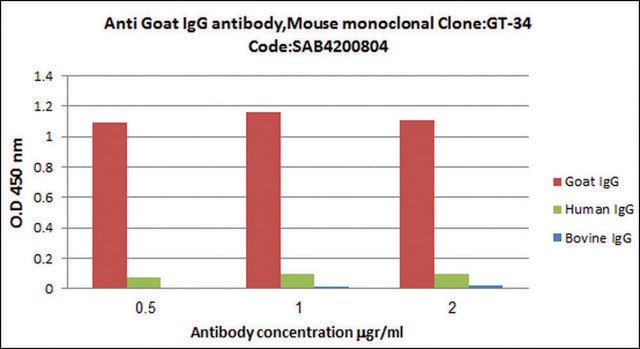
indirect ELISA: 1:10,000-1:20,000
isotype
IgG1
shipped in
dry ice
storage temp.
−20°C
target post-translational modification
unmodified
Looking for similar products? Visit Product Comparison Guide
Related Categories
General description
IgG is the main type of antibody in human serum, secreted by the B cells. It is found in blood. IgG consists of four polypeptide chains, made of two identical 50 kDa γ heavy (H) chains and two identical 25 kDa κ or λ light (L) chains, which are linked by inter-chain disulfide bonds. IgG contains four isotypes IgG1, IgG2, IgG3 and IgG4.
The antibody reacts with an epitope located on the heavy chain of goat IgG1 and IgG2.
Application
Monoclonal Anti-Goat/Sheep IgG antibody produced in mouse has been used in:
- enzyme linked immunosorbent assay (ELISA)
- immunoblotting
- immunoprecipitation
- immunoelectrophoresis
Biochem/physiol Actions
IgG stimulates the classical pathway of the complement system. It neutralizes virus particles and toxins. IgG plays a crucial role in antibody-dependent cell-mediated cytotoxicity (ADCC). IgG might be associated with allergy. It has the longest serum half life.
Monoclonal Anti-Goat/Sheep IgG recognizes an epitope located on the heavy chain of goat IgG1 and IgG2. The antibody shows strong cross-reactivity with sheep IgG and weak cross-reactivity with bovine IgG. No cross-reactivity is observed with IgG derived from human, guinea pig, rat, horse, dog, chicken, pig, mouse, rabbit, or cat.
Physical form
The product is provided as ascites fluid with 0.1% sodium azide as preservative.
Preparation Note
For continuous use, store at 2–8 °C for up to one month. For extended storage, solution may be frozen in working aliquots. Repeated freezing and thawing is not recommended. If slight turbidity occurs upon prolonged storage, clarify by centrifugation before use.
Disclaimer
Unless otherwise stated in our catalog or other company documentation accompanying the product(s), our products are intended for research use only and are not to be used for any other purpose, which includes but is not limited to, unauthorized commercial uses, in vitro diagnostic uses, ex vivo or in vivo therapeutic uses or any type of consumption or application to humans or animals.
Not finding the right product?
Try our Product Selector Tool.
Storage Class
10 - Combustible liquids
wgk_germany
nwg
flash_point_f
Not applicable
flash_point_c
Not applicable
Choose from one of the most recent versions:
Already Own This Product?
Find documentation for the products that you have recently purchased in the Document Library.
Tom N McNeilly et al.
Veterinary research, 44, 70-70 (2013-08-24)
Teladorsagia circumcincta is an important pathogenic nematode of sheep. It has been demonstrated previously that stimulation of murine T lymphocytes with excretory-secretory (ES) products derived from fourth stage larvae of T. circumcincta (Tci-L4-ES) results in de novo expression of Foxp3
Seasonal variations of phagocytic response, immunoglobulin G (IgG) and plasma cortisol levels in Dhofari goats
Al-Busaidi R, et al.
Small Ruminant Research, 79(2-3), 118-123 (2008)
Guillaume Sallé et al.
International journal for parasitology, 48(5), 395-402 (2018-03-15)
Some nematode species are economically important parasites of livestock, while others are important human pathogens causing some of the most important neglected tropical diseases. In both humans and animals, anthelmintic drug administration is the main control strategy, but the emergence
Reconstitution of Microtubule Nucleation InA Vitro Reveals Novel Roles for Mzt1.
Leong, et al.
Current Biology, 33, 1864-1864 (2023)
Brett Roberts et al.
Veterinary research, 44(1), 111-111 (2013-12-03)
With the problem of parasitic nematode drug resistance increasing, vaccine development offers an alternative sustainable control approach. For some parasitic nematodes, native extracts enriched for specific proteins are highly protective. However, recombinant forms of these proteins have failed to replicate
Related Content
Instructions
Our team of scientists has experience in all areas of research including Life Science, Material Science, Chemical Synthesis, Chromatography, Analytical and many others.
Contact Technical Service