Skip to Content
MilliporeSigma

G3923

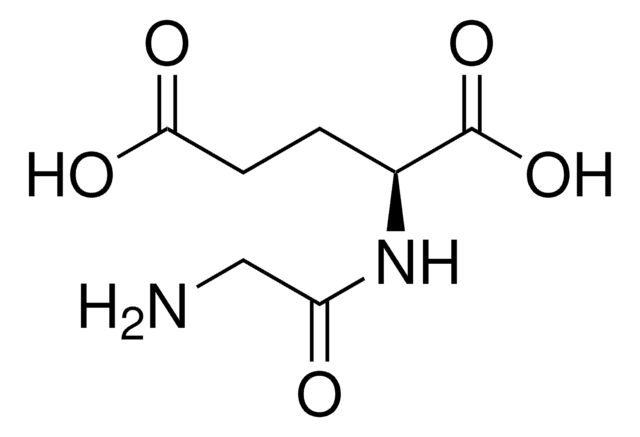
Gly-Pro-Glu

≥98% (HPLC), NMDA receptor antagonist., powder

Synonym(s):

GPE, Glycyl-prolyl-glutamic acid

Sign In to View Organizational & Contract Pricing.

Select a Size

Change View

About This Item

Empirical Formula (Hill Notation):
C12H19N3O6
CAS Number:
Molecular Weight:
301.30
UNSPSC Code:
12352209
PubChem Substance ID:
NACRES:
NA.32
MDL number:
Technical Service
Need help? Our team of experienced scientists is here for you.
Let Us Assist


Product Name

Gly-Pro-Glu, ≥98% (HPLC)

Quality Level

assay

≥98% (HPLC)

form

powder

color

white

storage temp.

−20°C

SMILES string

NCC(=O)N1CCC[C@H]1C(=O)N[C@@H](CCC(O)=O)C(O)=O

InChI

1S/C12H19N3O6/c13-6-9(16)15-5-1-2-8(15)11(19)14-7(12(20)21)3-4-10(17)18/h7-8H,1-6,13H2,(H,14,19)(H,17,18)(H,20,21)/t7-,8-/m0/s1

InChI key

JJGBXTYGTKWGAT-YUMQZZPRSA-N

General description

IGF1 (insulin-like growth factor 1) protein is cleaved into des-N-(1-3)-IGF-1 and an N-terminal Gly-Pro-Glu (GPE tripeptide). It is thought to be an outcome of specific neural processing.

Biochem/physiol Actions

Gly-Pro-Glu (GPE) is a neuroactive peptide and prevents the binding of glutamate to N-methyl-D-aspartate (NMDA) receptor. It positively regulates the potassium-mediated release of acetylcholine from rat cortical slices. Thus, it is involved in the control of brain function. In vitro studies show that this peptide confers neuroprotection to CA1-2 hippocampal neurons against excitotoxic insult.
Gly-Pro-Glu is a neuroprotective compound and the N-terminal tripeptide of IGF-1.
Gly-Pro-Glu is a neuroprotective compound and the N-terminal tripeptide of IGF-1. Gly-Pro-Glu is neuroprotective after central administration in animal models of neurodegenerative processes, such as Huntington′s, Parkinson′s, Alzheimer′s diseases, and varies acute brain injury animal models. The neuroprotective activity is not related to its affinity to glutamate receptor. Findings indicate that GPE mimics insulin-like growth factor I effects on the somatostatin system through a mechanism independent of β-amyloid clearance that involves modulation of calcium and glycogen synthase kinase 3β signaling.


Storage Class

11 - Combustible Solids

wgk

WGK 3

flash_point_f

Not applicable

flash_point_c

Not applicable


Choose from one of the most recent versions:

Certificates of Analysis (COA)

Lot/Batch Number

Don't see the Right Version?

If you require a particular version, you can look up a specific certificate by the Lot or Batch number.

Already Own This Product?

Find documentation for the products that you have recently purchased in the Document Library.

Visit the Document Library


J Guan et al.
Brain research, 859(2), 286-292 (2000-03-17)
The effect of the N-terminal tripeptide of insulin-like growth factor (IGF)-1, glycine-proline-glutamate (GPE), as a neuroprotective agent for nigro-striatal dopaminergic neurons was examined in the present study using a rat model of Parkinson's disease. A unilateral nigro-striatal lesion was induced
Max Jakobsson et al.
BMC musculoskeletal disorders, 20(1), 137-137 (2019-04-01)
Physical capacity tasks are useful tools to assess functioning in patients with low back pain (LBP), but evidence is scarce regarding the responsiveness (ability to detect change over time) and minimal important change (MIC). The aim was to investigate the
Armelle Darrasse et al.
BMC genomics, 14, 761-761 (2013-11-08)
Xanthomonads are plant-associated bacteria responsible for diseases on economically important crops. Xanthomonas fuscans subsp. fuscans (Xff) is one of the causal agents of common bacterial blight of bean. In this study, the complete genome sequence of strain Xff 4834-R was


Global Trade Item Number

SKUGTIN
G3923-50MG04061833218655
G3923-10MG04061833218648