Sign In to View Organizational & Contract Pricing.
Select a Size
About This Item
Conjugate:
unconjugated
Clone:
polyclonal
Application:
ELISA (i), QPA
Citations:
4
biological source
goat
Quality Level
conjugate
unconjugated
antibody form
whole antiserum
antibody product type
secondary antibodies
clone
polyclonal
contains
15 mM sodium azide
technique(s)
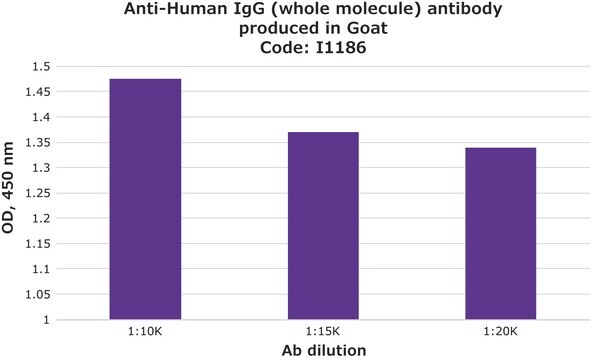
indirect ELISA: 1:50,000, quantitative precipitin assay: 4.0-7.0 mg/mL
shipped in
dry ice
storage temp.
−20°C
target post-translational modification
unmodified
Looking for similar products? Visit Product Comparison Guide
General description
Immunoglobulin G (IgG), a widely expressed serum antibody, has two heavy chains and two light chains connected by a disulfide bond. It is a glycoprotein, usually found as a monomer. IgG is further subdivided into four classes namely, IgG1, IgG2, IgG3, and IgG4. IgG antibody subtype is the most abundant of serum immunoglobulins of the immune system. About 70 % of the total immunoglobulin consists of IgG.
Application
Anti-Human IgG (Fc specific) antibody produced in goat has been used in enzyme-linked immunosorbent assay (ELISA).
Biochem/physiol Actions
Immunoglobulin G (IgG) mainly helps in immune defense. It participates in hypersensitivity type II and type III. It provides protection from infections caused by bacteria, fungi and viruses. Maternal IgG is transferred to fetus through the placenta that is vital for immune defense of the neonate against infections.
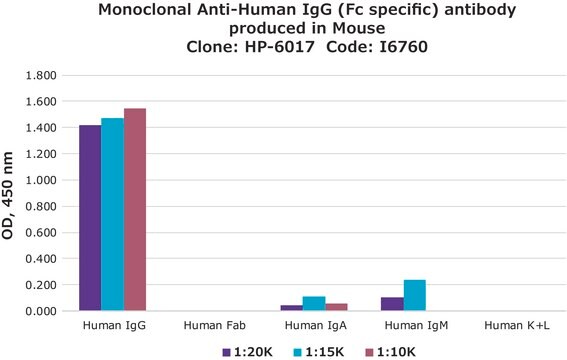
Specificity for the Fc fragment of human IgG is determined by immunoelectrophoresis (IEP) versus normal human serum and Fc fragment of human IgG. No reactivity is observed versus purified human IgA, IgG (Fab fragment), IgM, Bence Jones kappa and Bence Jones lambda myeloma proteins.
Physical form
Goat Anti-Human IgG is supplied as a liquid containing 0.1% sodium azide (see MSDS) as a preservative.
Preparation Note
For continuous use, store at 2-8°C for up to one month. For extended storage, the solution may be frozen in working aliquots. Repeated freezing and thawing is not recommended. Storage in "frost-free" freezers is not recommended. If slight turbidity occurs upon prolonged storage, clarify the solution by centrifugation before use. This goat antiserum was maintained at pH 5.0 for 40 minutes to meet U.S.D.A. requirements.
Disclaimer
Unless otherwise stated in our catalog or other company documentation accompanying the product(s), our products are intended for research use only and are not to be used for any other purpose, which includes but is not limited to, unauthorized commercial uses, in vitro diagnostic uses, ex vivo or in vivo therapeutic uses or any type of consumption or application to humans or animals.
Not finding the right product?
Try our Product Selector Tool.
Storage Class
10 - Combustible liquids
wgk
WGK 1
Choose from one of the most recent versions:
Already Own This Product?
Find documentation for the products that you have recently purchased in the Document Library.
Specific IgG for cat allergens in patients with allergic conjunctivitis
<BIG><BIG>Miyama A, et al</BIG></BIG>
International Ophthalmology, 35, 575-586 (2015)
Thomas McDonnell et al.
Frontiers in immunology, 9, 2244-2244 (2018-10-17)
Antiphospholipid antibodies (aPL), the serological hallmark of antiphospholipid syndrome (APS), are a heterogeneous group of autoantibodies raised against circulating blood proteins. Of these proteins, the phospholipid-binding b2-glycoprotein I (β2GPI) is considered to be the main autoantigen in APS. Indeed, IgG
Li-Ping Liu et al.
Cells, 11(1) (2022-01-12)
Amniotic epithelial stem cells (AESCs) are considered as potential alternatives to keratinocytes (KCs) in tissue-engineered skin substitutes used for treating skin damage. However, their clinical application is limited since similarities and distinctions between AESCs and KCs remain unclear. Herein, a
S Hashira et al.
Pediatrics international : official journal of the Japan Pediatric Society, 42(4), 337-342 (2000-09-15)
Maternal immunoglobulin G (IgG), transferred across the placenta to the fetus during intrauterine life, is an important component of the neonatal immunological defence mechanisms against infection. There is controversy with respect to differences in placental transfer of the different IgG
Related Content
Datasheet
Instructions
Our team of scientists has experience in all areas of research including Life Science, Material Science, Chemical Synthesis, Chromatography, Analytical and many others.
Contact Technical Service