Sign Into View Organizational & Contract Pricing
Select a Size
About This Item
Linear Formula:
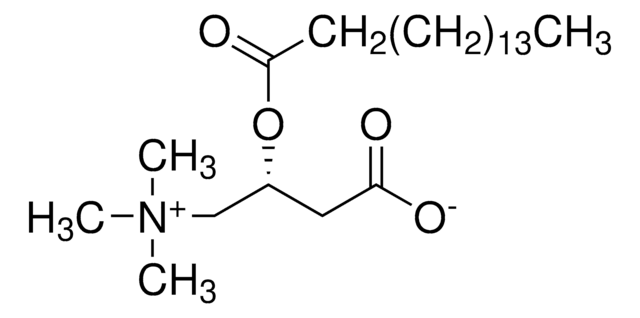
C23H46NO4 · Cl
CAS Number:
Molecular Weight:
436.07
MDL number:
UNSPSC Code:
12352200
PubChem Substance ID:
NACRES:
NA.77
Product Name
Palmitoyl-DL-carnitine chloride, powder
biological source
synthetic (organic)
Quality Level
assay
≥98% (TLC)
form
powder
color
white
solubility
H2O: 25 mg/mL (with heat or sonication)
storage temp.
−20°C
SMILES string
Cl.CCCCCCCCCCCCCCCC(=O)OC(CC(O)=O)C[N](C)(C)C
InChI
1S/C23H46NO4.ClH/c1-5-6-7-8-9-10-11-12-13-14-15-16-17-18-23(27)28-21(19-22(25)26)20-24(2,3)4;/h21H,5-20H2,1-4H3,(H,25,26);1H
InChI key
LGVBWSFTXDIBPB-UHFFFAOYSA-N
Related Categories
Application
Palmitoyl-DL-carnitine chloride has been used to study its effect on inflammatory cytokines and calcium (Ca2+) influx, using in vitro models of prostate cancer.
Biochem/physiol Actions
Long-chain acylcarnitine and well-known intermediate in mitochondrial fatty acid oxidation. Modifies myocardial levels of high-energy phosphates and free fatty acids in the heart. Increases erythroid colony formation in culture. Reduces surface negative charge of erythrocytes and myocytes. Reported to affect currents and inhibit endothelium-dependent relaxation induced by acetylcholine and substance P in a dose dependent manner by suppressing the intracellular calcium signal transduction in endothelial cells.
Palmitoyl-DL-carnitine chloride is known to inhibit biofilm formation mediated by Pseudomonas aeruginosa and Escherichia coli. It is a phosphokinase C inhibitor.
Storage Class
11 - Combustible Solids
wgk_germany
WGK 3
flash_point_f
Not applicable
flash_point_c
Not applicable
ppe
Eyeshields, Gloves, type N95 (US)
Choose from one of the most recent versions:
Already Own This Product?
Find documentation for the products that you have recently purchased in the Document Library.
Signal transduction of the prophenoloxidase-activating system of prawn haemocytes triggered by CpG oligodeoxynucleotides
Chuo CP, et al.
Fish & Shellfish Immunology, 18(2), 149-162 (2005)
N Inoue et al.
Cardiovascular research, 28(1), 129-134 (1994-01-01)
Palmitoyl-L-carnitine, which accumulates in ischaemic myocardium, may influence the function of vascular endothelium in the ischaemic area. The aim of the study was therefore to examine the effect of palmitoyl-L-carnitine on endothelium dependent relaxations of rabbit thoracic aortas and its
Activation and inhibition of reconstituted cardiac L-type calcium channels by palmitoyl-L-carnitine.
Q Y Liu et al.
Biochemical and biophysical research communications, 228(2), 252-258 (1996-11-12)
We have studied the effect of a palmitoyl-L-carnitine (L-PC) on single cardiac L-type Ca channels incorporated from porcine ventricular sarcolemma into planar lipid bilayers where we could control the concentration, intracellular and/or extracellular location, and duration of L-PC treatment. We
Chih Hung Lo et al.
Protein science : a publication of the Protein Society, 29(6), 1401-1415 (2020-01-22)
Tumor necrosis factor receptor 1 (TNFR1) is a transmembrane receptor that plays a key role in the regulation of the inflammatory pathway. While inhibition of TNFR1 has been the focus of many studies for the treatment of autoimmune diseases such
C Gruver et al.
Journal of molecular and cellular cardiology, 25(10), 1275-1284 (1993-10-01)
1-Palmitoylcarnitine (1-PC) reduced the electrophoretic mobility of human erythrocytes bathed in low ionic strength solution. Unlike divalent cations which appear to reduce electrophoretic mobility by screening surface negative charge, cationic 1-PC does so by being incorporated into the plasma membrane.
Our team of scientists has experience in all areas of research including Life Science, Material Science, Chemical Synthesis, Chromatography, Analytical and many others.
Contact Technical Service