Sign In to View Organizational & Contract Pricing.
Select a Size
Change View
About This Item
Empirical Formula (Hill Notation):
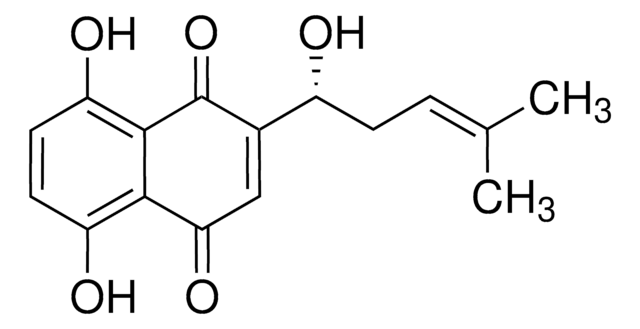
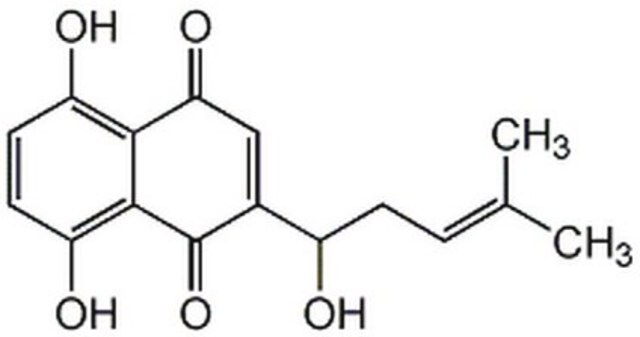
C16H16O5
CAS Number:
Molecular Weight:
288.30
NACRES:
NA.25
PubChem Substance ID:
UNSPSC Code:
12352200
MDL number:
Quality Segment
assay
≥98% (HPLC)
form
powder or solid
color
red to brown
solubility
methanol: 1 mg/mL
application(s)
metabolomics
vitamins, nutraceuticals, and natural products
storage temp.
2-8°C
SMILES string
C\C(C)=C\CC(O)C1=CC(=O)c2c(O)ccc(O)c2C1=O
InChI
1S/C16H16O5/c1-8(2)3-4-10(17)9-7-13(20)14-11(18)5-6-12(19)15(14)16(9)21/h3,5-7,10,17-19H,4H2,1-2H3
InChI key
NEZONWMXZKDMKF-UHFFFAOYSA-N
General description
Shikonin is a major phytochemical compound extracted from the roots of Lithospermum erythrorhizon. It is a natural anthraquinone derivative.
Application
Shikonin has been used:
- to enhance the anti-tumor activity of gefitinib on tyrosine kinase receptor epidermal growth factor receptor (EGFR) in wild-type lung cancer cells
- as an inhibitor of renal aerobic glycosis and a potential
- as an anti-inflammatory agent to test its role to improve lipopolysaccharide (LPS)-induced cardiac dysfunction
- to stimulate bone marrow-derived macrophages (BMDMs) to test the effect of Interferon regulatory factor 1 on cell death
Biochem/physiol Actions
Inhibits chemokine receptor function and suppresses HIV-1. Circumvents cancer drug resistance by induction of cell death through a necroptotic pathway. Treatment of cancer cells with shikonin suppressed glycolysis via the inhibition of pyruvate kinase M2 (PKM2).
Naphthoquinone isolated from Arnebia sp. Used as an anti-inflammatory treatment in traditional chinese medicine (TCM). Inhibits chemokine receptor function and suppresses HIV-1.† Circumvents cancer drug resistance by induction of cell death through a necroptotic pathway.† Treatment of cancer cells with shikonin suppressed glycolysis via the inhibition of pyruvate kinase M2 (PKM2).
Shikonin is a potent anti-fungal agent against C. albicans biofilms. It displays anti-oxidant and chemotherapeutic properties on human glioma cells.
signalword
Warning
hcodes
Hazard Classifications
Acute Tox. 4 Oral - Aquatic Acute 1
Storage Class
11 - Combustible Solids
wgk
WGK 3
flash_point_f
Not applicable
flash_point_c
Not applicable
Choose from one of the most recent versions:
Already Own This Product?
Find documentation for the products that you have recently purchased in the Document Library.
Seetharaman Rajasekar et al.
Journal of ethnopharmacology, 144(2), 335-345 (2012-09-22)
Lithospermum erythrorhizon has long been used in traditional Asian medicine for the treatment of diseases including skin cancer. In this study, hexane extract from the roots of Lithospermum erythrorhizon (LEH) was chemically characterized and its anticancer activity was tested against
Chuanjie Guo et al.
Pharmacological research, 149, 104463-104463 (2019-09-26)
Shikonin is the major bioactive component extracted from the roots of Lithospermum erythrorhizon which is also known as "Zicao" in Traditional Chinese Medicine (TCM). Recent studies have shown that shikonin demonstrates various bioactivities related to the treatment of cancer, inflammation
Kanwal Ahmed et al.
International journal of hyperthermia : the official journal of European Society for Hyperthermic Oncology, North American Hyperthermia Group, 28(1), 1-8 (2012-01-13)
Environmental stress induces damage that activates an adaptive response in any organism. The cellular stress response is based on the induction of cytoprotective proteins, the so-called stress or heat shock proteins (HSPs). HSPs are known to function as molecular chaperones
Global Trade Item Number
| SKU | GTIN |
|---|---|
| S7576-50MG | 04061832411088 |
| S7576-10MG | 04061836960117 |