Sign In to View Organizational & Contract Pricing.
Select a Size
About This Item
UNSPSC Code:
12352203
NACRES:
NA.41
eCl@ss:
32160702
Conjugate:
unconjugated
Clone:
PAb416, monoclonal
Application:
ICC, WB
Citations:
20
biological source
mouse
conjugate
unconjugated
antibody form
purified antibody
antibody product type
primary antibodies
clone
PAb416, monoclonal
species reactivity
SV40-infected cells
technique(s)
immunocytochemistry: suitable, western blot: suitable
isotype
IgG2aκ
NCBI accession no.
UniProt accession no.
shipped in
wet ice
target post-translational modification
unmodified
Quality Level
General description
Both the Simian virus (SV40) large T and small T antigens are encoded by the early region of the SV40 genome. The large T antigen binds DNA, and complexes with a 53,000 dalton cellular protein, p53, which is required for initiation of viral DNA replication during lytic growth. In addition the large T antigen binds DNA polymerase and the transcription factor AP-2 and forms a specific complex with the P105 product of the retinoblastoma susceptibility gene.
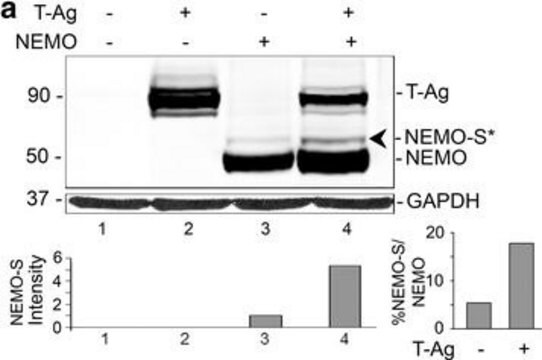
~82 kDa observed
Immunogen
Epitope: Large T antigen of SV40
Purified large T-antigen of SV40
Application
Research Category
Inflammation & Immunology
Research Sub Category
Immunoglobulins & Immunology
Anti-SV40 Large T Antigen Antibody, clone PAb416 is an antibody against SV40 Large T Antigen for use in Western Blotting, ICC.
Immunocytochemistry Analysis: A representative lot from an independent laboratory detected SV40 Large T Antigen in ICC (Sabatier, J., et al. (2005). 58(4):429-431.; Del Valle, L., et al. (2004). J Virol. 78(7):3462-3469.).
Biochem/physiol Actions
This antibody recognizes the large T antigen of SV40.
Physical form
Format: Purified
Protein G Purified
Purified mouse monoclonal IgG2aκ in buffer containing 0.1 M Tris-Glycine (pH 7.4), 150 mM NaCl with 0.05% sodium azide.
Preparation Note
Stable for 1 year at 2-8°C from date of receipt.
Analysis Note
Control
Cos-1 cell lysate
Cos-1 cell lysate
Evaluated by Western Blot in Cos-1 cell lysate.
Western Blot Analysis: 1 µg/mL of this antibody detected SV40 Large T Antigen in 10 µg of Cos-1 cell lysate.
Other Notes
Concentration: Please refer to the Certificate of Analysis for the lot-specific concentration.
Disclaimer
Unless otherwise stated in our catalog or other company documentation accompanying the product(s), our products are intended for research use only and are not to be used for any other purpose, which includes but is not limited to, unauthorized commercial uses, in vitro diagnostic uses, ex vivo or in vivo therapeutic uses or any type of consumption or application to humans or animals.
Not finding the right product?
Try our Product Selector Tool.
Storage Class
12 - Non Combustible Liquids
wgk
WGK 1
flash_point_f
Not applicable
flash_point_c
Not applicable
Certificates of Analysis (COA)
Search for Certificates of Analysis (COA) by entering the products Lot/Batch Number. Lot and Batch Numbers can be found on a product’s label following the words ‘Lot’ or ‘Batch’.
Already Own This Product?
Find documentation for the products that you have recently purchased in the Document Library.
Linda C Knight et al.
Journal of molecular biomarkers & diagnosis, 1(1) (2010-01-01)
A targeted nanoconjugate is being developed for non-invasive detection of gene expression in cells expressing the JC virus oncoprotein, T-antigen, which has been associated with medulloblastoma and other cancers. JC virus T-antigen localizes predominantly to the nucleus via a classical
Luis Del Valle et al.
Viruses, 12(11) (2020-11-07)
Progressive Multifocal Leukoencephalopathy (PML) is a fatal demyelinating disease of the CNS, resulting from the lytic infection of oligodendrocytes by the human neurotropic polyomavirus JC (JCPyV), typically associated with severe immunocompromised states and, in recent years, with the use of
Marie N Sorin et al.
Cell reports, 42(2), 112114-112114 (2023-02-16)
BK polyomavirus (BKPyV) is an opportunistic pathogen that uses the b-series gangliosides GD1b and GT1b as entry receptors. Here, we characterize the impact of naturally occurring VP1 mutations on ganglioside binding, VP1 protein structure, and virus tropism. Infectious entry of
David Leuenberger et al.
Clinical and vaccine immunology : CVI, 14(8), 959-968 (2007-06-01)
Impaired BK virus (BKV)-specific immunity is a key risk factor of polyomavirus-associated nephropathy. We hypothesized that BKV agnoprotein might constitute an important immune target, as it is highly expressed after infection in vitro. We demonstrate abundant expression of BKV agnoprotein
Sonia Ramamoorthy et al.
Cancer, 117(11), 2379-2385 (2011-06-01)
Anal carcinoma is thought to be driven by human papillomavirus (HPV) infection through interrupting function of cell regulatory proteins such as p53 and pRb. John Cunningham virus (JCV) expresses a T-antigen that causes malignant transformation through development of aneuploidy and
Our team of scientists has experience in all areas of research including Life Science, Material Science, Chemical Synthesis, Chromatography, Analytical and many others.
Contact Technical Service