

Recommended Products




product line
BioReagent
Quality Level
assay
≥90.0% (HPLC)
form
solid
manufacturer/tradename
ATTO-TEC GmbH
λ
in ethanol (with 0,1% trifluoroacetic acid)
UV absorption
λ: 627-633 nm Amax
suitability
suitable for fluorescence
storage temp.
−20°C
Application
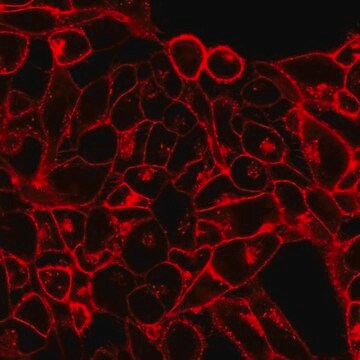
Atto 633 is a red-emitting fluorescence label with strong absorption, high quantum yield (64%), high photostability, good water solubility, and very little triplet formation. This label is optimized for use with diode laser excitation at 633 nm and characterized by high photostability.
Legal Information
This product is for Research use only. In case of intended commercialization, please contact the IP-holder (ATTO-TEC GmbH, Germany) for licensing.
Storage Class
11 - Combustible Solids
wgk_germany
WGK 3
flash_point_f
Not applicable
flash_point_c
Not applicable
ppe
Eyeshields, Gloves, type N95 (US)
Choose from one of the most recent versions:
Already Own This Product?
Find documentation for the products that you have recently purchased in the Document Library.
Customers Also Viewed
Martin Beutler et al.
European biophysics journal : EBJ, 38(1), 69-82 (2008-09-05)
We demonstrate theoretically and experimentally the quantification of Förster resonance energy transfer (FRET) by direct and systematic saturation of the excited state of acceptor molecules. This version of acceptor depletion methods for FRET estimation, denoted as "satFRET" is reversible and
Sotirios S Tragoulias et al.
Analytical and bioanalytical chemistry, 390(6), 1563-1573 (2008-01-30)
Microarray technology covers the urgent need to exploit the accumulated genetic information from large-scale sequencing projects and facilitate investigations on a genome-wide scale. Although most applications focus on DNA microarrays, the technology has expanded to microarrays of proteins, peptides, carbohydrates
Thomas D Lazzara et al.
Journal of colloid and interface science, 366(1), 57-63 (2011-10-29)
Anodic aluminum oxide (AAO) substrates with aligned, cylindrical, non-intersecting pores with diameters of 75 nm and depths of 3.5 or 10 μm were functionalized with lipid monolayers harboring different receptor lipids. AAO was first functionalized with dodecyl-trichlorosilane, followed by fusion
Maria Strianese et al.
Protein and peptide letters, 18(3), 282-286 (2010-09-23)
A new, fast, simple and cost-effective sensing device for monitoring H(2)S has been developed. Proof-of-principle results showing that a commercial and cheap Myoglobin (Mb) can be successfully used as a biological probe for a fluorescence biosensor for H(2)S detection are
Julian Weichsel et al.
Cytometry. Part A : the journal of the International Society for Analytical Cytology, 77(1), 52-63 (2009-11-10)
The actin cytoskeleton modulates a large variety of physiological and disease-related processes in the cell. For example, actin has been shown to be a crucial host factor for successful infection by HIV-1, but the underlying mechanistic details are still unknown.
Articles
Fluorescence lifetime measurement is advantageous over intensity-based measurements. Applications include fluorescence lifetime assays, sensing and FLI.
Our team of scientists has experience in all areas of research including Life Science, Material Science, Chemical Synthesis, Chromatography, Analytical and many others.
Contact Technical Service