Skip to Content
MilliporeSigma

E0282

MaxGel ECM

mixture, liquid

Synonym(s):

Human Basement Membrane Extract (BME)

Sign In to View Organizational & Contract Pricing.

Select a Size


About This Item

UNSPSC Code:
12352207
NACRES:
NA.71
eCl@ss:
32190102
Technical Service
Need help? Our team of experienced scientists is here for you.
Let Us Assist
Technical Service
Need help? Our team of experienced scientists is here for you.
Let Us Assist

Product Name

MaxGel ECM, mixture, liquid

form

liquid

storage temp.

−70°C

Quality Level

Looking for similar products? Visit Product Comparison Guide

Application

MaxGel ECM is used for the following applications:
  • Extracellular matrix (ECM) protein binding assays
  • Cell invasion assay
  • Cell culture
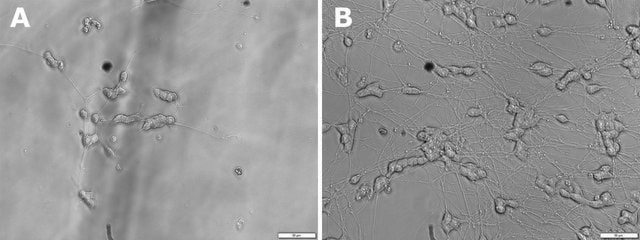
This product creates a three-dimensional environment that improves cellular proflieration by promoting cell growth and migration, and has been shown to aid the proliferation of many types of cells, including human embryonic stem cells, neural stem cells, neurons, glia, astrocytes, fibroblasts, hepatocytes, and keratinocytes.

Disclaimer

MaxGel will remain stable for at least 1 year when stored at -70°C.

Other Notes

MaxGel ECM contains human extracellular matrix components including collagens, laminin, fibronectin, tenascin, elastin and a number of proteoglycans and glycosaminoglycans. This basement membrane extract reproduces the cooperative interactions between epithelia and mesenchyme that occur during the development and organotypic cell culture of skin.

Legal Information

MaxGel is a trademark of Sigma-Aldrich Co. LLC

Storage Class

12 - Non Combustible Liquids

wgk

WGK 3

flash_point_f

Not applicable

flash_point_c

Not applicable


Choose from one of the most recent versions:

Certificates of Analysis (COA)

Lot/Batch Number

Don't see the Right Version?

If you require a particular version, you can look up a specific certificate by the Lot or Batch number.

Already Own This Product?

Find documentation for the products that you have recently purchased in the Document Library.

Visit the Document Library

Bin He et al.
Oncology reports, 29(3), 1115-1123 (2012-12-21)
LIM and SH3 protein 1 (LASP1) is an actin-binding protein which is overexpressed in many types of cancers and plays important roles in cancer progression. however, the role of LASP1 in esophageal squamous cell carcinoma (ESCC) is still unknown. We sought
H M Sharon Goh et al.
Applied and environmental microbiology, 79(21), 6535-6543 (2013-08-21)
Acinetobacter baumannii is a multidrug-resistant pathogen associated with hospital outbreaks of infection across the globe, particularly in the intensive care unit. The ability of A. baumannii to survive in the hospital environment for long periods is linked to antibiotic resistance
Kang Li et al.
International journal of clinical and experimental pathology, 8(9), 10941-10946 (2015-12-01)
This study aims to explore the effects of vein subvolution combined with neural stem cells on nerve regeneration. Animal model of sciatic nerve defects was established with SD rats. A total of 63 SD rats were divided into control group
Pyrimido[4,5-d]pyrimidin-4(1H)-one derivatives as selective inhibitors of EGFR threonine790 to methionine790 (T790M) mutants.
Tianfeng Xu et al.
Angewandte Chemie (International ed. in English), 52(32), 8387-8390 (2013-06-28)
J Křivánek et al.
Folia biologica, 60 Suppl 1, 30-38 (2014-11-05)
Neural crest cells (NCCs) derive early in vertebrate ontogenesis from neural tube as a population of migratory cells with exquisite differentiation potential. Abnormalities in NCC behaviour are cause of debilitating diseases including cancers and a spectrum of neurocristopathies. Thanks to

Articles

3D cell culture overview. Learn about 2D vs 3D cell culture, advantages of 3D cell culture, and techniques available to develop 3D cell models

Hydrogela are the most widely used systems for 3D cell culture. Learn more about this technology (what are hydrogels? How to chose?)

Human cell derived basement membrane extract (BME) hydrogel for 3D cell culture of primary cell, stem cell and xenograph cancer models.

Related Content

Instructions

Our team of scientists has experience in all areas of research including Life Science, Material Science, Chemical Synthesis, Chromatography, Analytical and many others.

Contact Technical Service