
G4541

Gly-Gly-His
≥98% (TLC)
Synonym(s):
Copper-binding peptide
Sign Into View Organizational & Contract Pricing
All Photos(1)
About This Item
Empirical Formula (Hill Notation):
C10H15N5O4
CAS Number:
Molecular Weight:
269.26
MDL number:
UNSPSC Code:
12352209
NACRES:
NA.26
Pricing and availability is not currently available.
Recommended Products



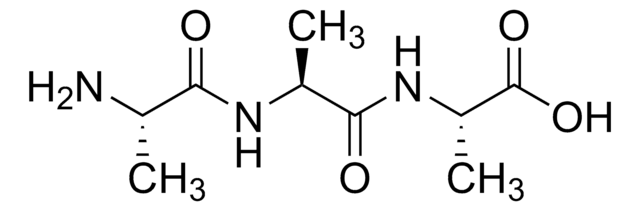
Product Name
Gly-Gly-His,
assay
≥98% (TLC)
Quality Level
form
solid
color
white
storage temp.
−20°C
InChI
1S/C10H15N5O4/c11-2-8(16)13-4-9(17)15-7(10(18)19)1-6-3-12-5-14-6/h3,5,7H,1-2,4,11H2,(H,12,14)(H,13,16)(H,15,17)(H,18,19)
InChI key
PDAWDNVHMUKWJR-UHFFFAOYSA-N
Related Categories
Amino Acid Sequence
Gly-Gly-His
General description
Application
Gly-Gly-His has been used:
- as a peptide test probe in the hydrophilic interaction liquid chromatography (HILIC) studies[2]
- in the electrochemical modification of back-side contact transducers (BSC) electrodes in copper (Cu2+) sensing studies[1]
- for the fabrication carbon nanotube electrode for detection of Cu2+ ions[3]
Biochem/physiol Actions
Gly-Gly-His (GGH) tripeptide displays the affinity of copper (Cu2+) complexation.[1] These complexes display good skin tolerance[1] and may be useful in wound healing.[4] GGH copper complexes are proposed to reduce tumor necrosis factor α (TNF-α)-based interleukin 6 (IL-6) secretion by in vivo studies with fibroblasts.[4] GGH is used in comparative studies with other imidazole-containing peptides such as carnosine. An area of active application research involves the GGH binding of copper ions.[3]
Storage Class
11 - Combustible Solids
wgk_germany
WGK 3
flash_point_f
Not applicable
flash_point_c
Not applicable
ppe
Eyeshields, Gloves, type N95 (US)
Choose from one of the most recent versions:
Already Own This Product?
Find documentation for the products that you have recently purchased in the Document Library.
Customers Also Viewed

Hirokazu Hamada et al.
Journal of inorganic biochemistry, 101(10), 1529-1536 (2007-08-21)
DNA fiber EPR was used to investigate the DNA binding stabilities and orientations of Cu(II).Gly-Gly-His-derived metallopeptides containing D- vs. L-amino acid substitutions in the first peptide position. This examination included studies of Cu(II).D-Arg-Gly-His and Cu(II).D-Lys-Gly-His for comparison to metallopeptides containing
Electrochemical detection of copper using a Gly-Gly-His modified carbon nanotube biosensor
Flavel BS, et al.
Silicon, 3(4) (3)
K C Brown et al.
Biochemistry, 34(14), 4733-4739 (1995-04-11)
The Ni(II) complex of the tripeptide NH2-Gly-Gly-His-COOH is shown to mediate efficient protein-protein cross-linking in the presence of oxidants such as oxone and monoperoxyphthalic acid. Only proteins that associate specifically in solution are cross-linked under these conditions. Preliminary probes of
Ken Yokawa et al.
Bioscience, biotechnology, and biochemistry, 75(7), 1377-1379 (2011-07-09)
Free divalent ions of copper (Cu) are capable of generating radical species such as hydroxyl radicals in the presence of hydrogen peroxide or ascorbic acid through Harbor-Weiss-like reactions under physiological conditions. It has been reported that radical-mediated damage to DNA
Meng Lin et al.
Biosensors & bioelectronics, 26(2), 940-945 (2010-07-16)
We developed a novel biosensor comprising a transducer of carboxyl end-capped overoxidized polypyrrole nanowire electrode and a probe of tripeptide (Gly-Gly-His) selectively cognitive of Cu2+. The developed sensor was demonstrated to specifically detect Cu2+ in the nanomolar range. The diameter
Our team of scientists has experience in all areas of research including Life Science, Material Science, Chemical Synthesis, Chromatography, Analytical and many others.
Contact Technical Service


