Sign In to View Organizational & Contract Pricing.
Select a Size
About This Item
NACRES:
NA.46
UNSPSC Code:
12352203
Product Name
Monoclonal Anti-Human IgE antibody produced in mouse, clone GE-1, ascites fluid
isotype
IgG2b
biological source
mouse
conjugate
unconjugated
antibody form
ascites fluid
antibody product type
secondary antibodies
clone
GE-1, monoclonal
contains
15 mM sodium azide
technique(s)
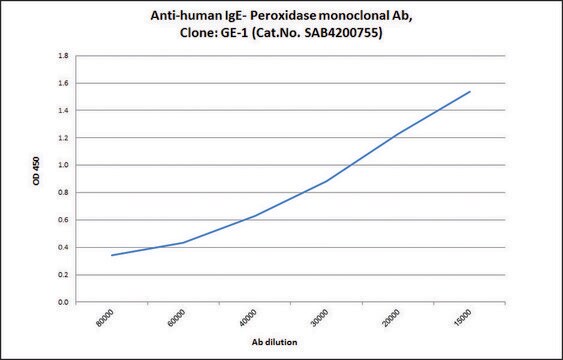
indirect ELISA: 1:5,000
shipped in
dry ice
storage temp.
−20°C
target post-translational modification
unmodified
Quality Level
Looking for similar products? Visit Product Comparison Guide
Analysis Note
The antibody is tested for reactivity against myeloma IgE and allergy-elevated IgE.
Application
To confirm that a chimaeric monoclonal antibody had episolon chain, an elisa was performed using monoclonal anti-human IgE antibody (clone GE1) at a 1:1000 dilution.
Biochem/physiol Actions
Immunoglobulin E (IgE) is implicated in acute allergic reactions and chronic inflammatory allergic diseases, such as allergic asthma and chronic urticaria (CU). Receptor bounded IgE aids antigen uptake and modulates the differentiation and proliferation of B cells. It confers immunity against helminthic parasites. IgE is also involved in facilitating type I hypersensitivity reactions. It regulates mast cell homeostasis and also exhibits immunomodulatory effects.
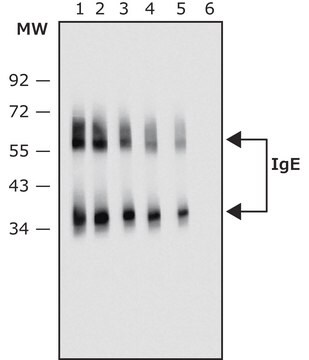
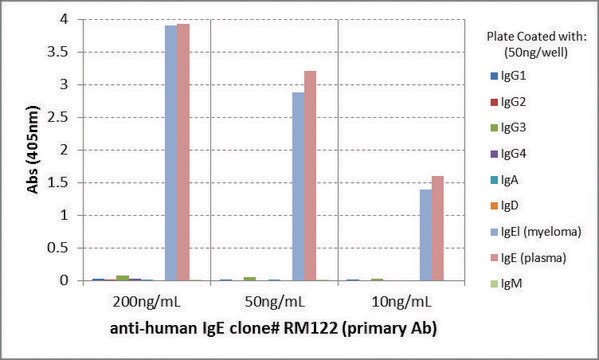
Monoclonal Anti-Human IgE is immunospecific for human IgE. No cross-reactivity with human IgG, IgM or purified light chains is observed.
Disclaimer
Unless otherwise stated in our catalog or other company documentation accompanying the product(s), our products are intended for research use only and are not to be used for any other purpose, which includes but is not limited to, unauthorized commercial uses, in vitro diagnostic uses, ex vivo or in vivo therapeutic uses or any type of consumption or application to humans or animals.
General description
Binds human IgE; does not bind human IgG, IgA or IgM.
Monoclonal Anti-Human IgE (mouse IgG2b isotype) is derived from the hybridoma produced by the fusion of mouse myeloma cells and splenocytes from an immunized mouse. Immunoglobulin E (IgE) antibodies are tetramers with two light chains (κ or λ) and two ε-heavy connected by numerous intrachain disulfide bonds. IgE exists in two isoforms, one is associated with the B cell receptor and the other being secreted by plasma cell. It has a short life span in plasma when compared to receptor bounded IgE.
Physical form
The product is provided as ascites fluid with 0.1% sodium azide as a preservative.
Preparation Note
For continuous use, store at 2-8 °C for up to one month. For extended storage, the solution may be frozen in working aliquots. Repeated freezing and thawing is not recommended. Storage in "frost-free" freezers is not recommended. If slight turbidity occurs upon prolonged storage, clarify the solution by centrifugation before use.
Not finding the right product?
Try our Product Selector Tool.
Storage Class
10 - Combustible liquids
wgk
nwg
flash_point_f
Not applicable
flash_point_c
Not applicable
Choose from one of the most recent versions:
Already Own This Product?
Find documentation for the products that you have recently purchased in the Document Library.
Hans C Oettgen
The Journal of allergy and clinical immunology, 137(6), 1631-1645 (2016-06-07)
Fifty years ago, after a long search, IgE emerged as the circulating factor responsible for triggering allergic reactions. Its extremely low concentration in plasma created significant hurdles for scientists working to reveal its identity. We now know that IgE levels
Rupert J Quinnell et al.
The Journal of infectious diseases, 190(3), 430-438 (2004-07-10)
Cytokine and proliferative responses to Necator americanus infection were measured in a treatment-reinfection study of infected subjects from an area of Papua New Guinea where N. americanus is highly endemic. Before treatment, most subjects produced detectable interleukin (IL)-4 (97%), IL-5
Wondossen Sime et al.
Journal of immunology (Baltimore, Md. : 1950), 183(7), 4657-4665 (2009-09-16)
Mast cells (MCs) are multifunctional effectors of the immune system that are distributed in many tissues, often in close association with the basement membrane of blood vessels, epithelium and nerves. Laminins (LMs), a family of large alphabetagamma heterotrimeric proteins, are
Jessy Elst et al.
Methods in molecular biology (Clifton, N.J.), 2163, 213-218 (2020-08-09)
The basis of traditional flow cytometry allergy diagnosis is measurement of the expression of basophilic surface activation and/or degranulation markers. Basophils, upon encounter with a specific allergen that cross-links surface FcRI-bound IgE antibodies, not only secrete and release quantifiable bioactive
S Nullens et al.
Cytometry. Part B, Clinical cytometry, 84(3), 173-178 (2013-03-02)
Despite the efficiency of venom immunotherapy, the effects on basophils and mast cells remain incompletely understood and probably vary according to the treatment phase. To study the effect of build-up and maintenance venom immunotherapy on individual basophils. Intracellular histamine and
Related Content
Datasheet
Our team of scientists has experience in all areas of research including Life Science, Material Science, Chemical Synthesis, Chromatography, Analytical and many others.
Contact Technical Service