Skip to Content
MilliporeSigma
Get 22% off for Pi Day through March 31.Save Now

H8126

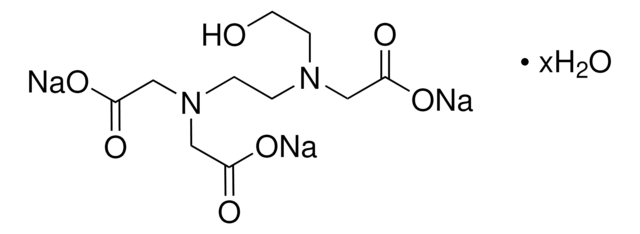
N-(2-Hydroxyethyl)ethylenediamine-N,N′,N′-triacetic acid

~98%

Synonym(s):

N-Carboxymethyl-N′-(2-hydroxyethyl)-N,N′-ethylenediglycine, HEDTA, HEEDTA

Sign In to View Organizational & Contract Pricing.

Select a Size


About This Item

Linear Formula:
HOCH2CH2N(CH2CO2H)CH2CH2N(CH2CO2H)2
CAS Number:
Molecular Weight:
278.26
UNSPSC Code:
12352116
NACRES:
NA.22
PubChem Substance ID:
EC Number:
205-759-3
Beilstein/REAXYS Number:
1804795
MDL number:
Assay:
~98%
Form:
powder
Technical Service
Need help? Our team of experienced scientists is here for you.
Let Us Assist
Technical Service
Need help? Our team of experienced scientists is here for you.
Let Us Assist

Quality Level

assay

~98%

form

powder

mp

212 °C (dec.) (lit.)

SMILES string

OCCN(CCN(CC(O)=O)CC(O)=O)CC(O)=O

InChI

1S/C10H18N2O7/c13-4-3-11(5-8(14)15)1-2-12(6-9(16)17)7-10(18)19/h13H,1-7H2,(H,14,15)(H,16,17)(H,18,19)

InChI key

URDCARMUOSMFFI-UHFFFAOYSA-N

Looking for similar products? Visit Product Comparison Guide

Application

N-(2-Hydroxyethyl)ethylenediamine-N,N′,N′-triacetic acid (HEDTA) can be used as an ionophore for the selective determination of Fe(III) ions by the potentiometric method. It is also used to form complexes with metal ions such as iron(II), copper (II), zinc(II), manganese(II), and uranium(VI) ions. Therefore, HEDTA plays an important role in the separation of f-elements and the treatment and disposal of nuclear waste.

pictograms

CorrosionExclamation mark

signalword

Danger

Hazard Classifications

Acute Tox. 4 Oral - Eye Dam. 1 - Skin Irrit. 2

Storage Class

11 - Combustible Solids

wgk

WGK 2

flash_point_f

Not applicable

flash_point_c

Not applicable

ppe

dust mask type N95 (US), Eyeshields, Gloves


Choose from one of the most recent versions:

Certificates of Analysis (COA)

Lot/Batch Number

Don't see the Right Version?

If you require a particular version, you can look up a specific certificate by the Lot or Batch number.

Already Own This Product?

Find documentation for the products that you have recently purchased in the Document Library.

Visit the Document Library

Y M Tzou et al.
Journal of environmental quality, 32(6), 2076-2084 (2003-12-17)
Detoxification of Cr(VI) through reduction has been considered an effective method for reclaiming Cr-contaminated soil, sediment, and waste water. Organic matter is widely distributed in soil and aquatic systems; however, low Cr(VI) reduction rates inhibit the adoption of Cr reduction
H Chen et al.
Chemosphere, 45(1), 21-28 (2001-09-27)
Phytoremediation has shown great potential as an alternative treatment for the remediation of heavy-metal-contaminated soils and groundwater. However, the lack of a clear understanding pertaining to metal uptake/translocation mechanisms, enhancement amendments, and external effects on phytoremediation has hindered its full-scale
Anders D Nielsen et al.
Analytical biochemistry, 314(2), 227-234 (2003-03-26)
Determination of binding parameters for metal ion binding to proteins usually requires preceding steps to remove protein-bound metal ions. Removal of bound metal ions from protein is often associated with decreased stability and inactivation. We present two simple isothermal titration
ZuLiang Chen et al.
Analytical and bioanalytical chemistry, 374(3), 520-525 (2002-10-10)
An on-column complexation method has been developed for the simultaneous determination of V(IV) and V(V). Vanadium species were chelated with aminopolycarboxylic acids to form anionic complexes which were separated by capillary zone electrophoresis (CZE) with direct UV detection. Ethylenediaminetetraacetic acid
Valentina Bambagioni et al.
Journal of medicinal chemistry, 51(11), 3250-3260 (2008-05-20)
The synthesis of the Fe(III), Co(II), Mn(II), and Ru(III) complexes with two polyamine-polycarboxylate ligands, N-(2-hydroxyethyl)ethylenediamine-N, N', N'-triacetic acid (H3L1) and ethylene bisglycol tetraacetic acid (H4L2) is reported. Potentiometric studies showed that these ligands form stable complexes in aqueous solution and

Our team of scientists has experience in all areas of research including Life Science, Material Science, Chemical Synthesis, Chromatography, Analytical and many others.

Contact Technical Service