Skip to Content
MilliporeSigma

M0285

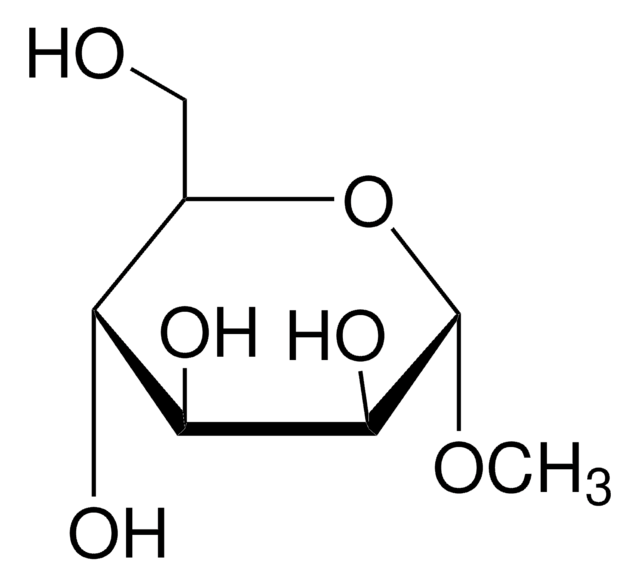
Methyl-β-D-galactopyranoside

Synonym(s):

Methyl β-D-galactoside

Sign In to View Organizational & Contract Pricing.

Select a Size


About This Item

Empirical Formula (Hill Notation):
C7H14O6
CAS Number:
Molecular Weight:
194.18
UNSPSC Code:
12352201
NACRES:
NA.25
PubChem Substance ID:
EC Number:
217-361-7
Beilstein/REAXYS Number:
81569
MDL number:
Technical Service
Need help? Our team of experienced scientists is here for you.
Let Us Assist
Technical Service
Need help? Our team of experienced scientists is here for you.
Let Us Assist

InChI key

HOVAGTYPODGVJG-VOQCIKJUSA-N

InChI

1S/C7H14O6/c1-12-7-6(11)5(10)4(9)3(2-8)13-7/h3-11H,2H2,1H3/t3-,4+,5+,6-,7-/m1/s1

SMILES string

CO[C@@H]1O[C@H](CO)[C@H](O)[C@H](O)[C@H]1O

biological source

synthetic

assay

≥98% (GC)

form

powder

technique(s)

gas chromatography (GC): suitable

color

white to faint yellow

mp

176-179  °C

solubility

water: 50 mg/mL, clear, colorless

storage temp.

2-8°C

Quality Level

General description

A β-D-galactopyranoside having a methyl substituent at the anomeric position.

Biochem/physiol Actions

Methyl galactoside is a hexose involved in the metabolism of 2-deoxygalactose.

Other Notes

To gain a comprehensive understanding of our extensive range of Monosaccharides for your research, we encourage you to visit our Carbohydrates Category page.

Storage Class

11 - Combustible Solids

wgk

WGK 3

flash_point_f

Not applicable

flash_point_c

Not applicable

ppe

Eyeshields, Gloves, type N95 (US)


Choose from one of the most recent versions:

Certificates of Analysis (COA)

Lot/Batch Number

Don't see the Right Version?

If you require a particular version, you can look up a specific certificate by the Lot or Batch number.

Already Own This Product?

Find documentation for the products that you have recently purchased in the Document Library.

Visit the Document Library

Peter Capek
Carbohydrate research, 343(8), 1390-1393 (2008-04-25)
An arabinogalactan with a high content of 3-O-methyl-D-galactose residues has been isolated from the aerial parts of sage (Salvia officinalis L.). Structural studies of the polymer indicated a beta-1,6-D-galactopyranose backbone in which at least one-third of D-galactopyranosyl residues carries methoxyl
María del Carmen Fernández-Alonso et al.
Journal of the American Chemical Society, 127(20), 7379-7386 (2005-05-19)
The existence of stabilizing carbohydrate-aromatic interactions is demonstrated from both the theoretical and experimental viewpoints. The geometry of experimentally based galactose-lectin complexes has been properly accounted for by using a MP2/6-31G(d,p) level of theory and by considering a counterpoise correction
M E Winkler et al.
Journal of inorganic biochemistry, 14(3), 223-235 (1981-06-01)
Alcohol substrate binding to the copper-containing enzyme galactose oxidase (GOase) has been studied by kinetic competition against cyanide and fluoride, 13C nmr relaxation, and esr competition experiments. The 13C nmr spectra of the substrate beta-O-methyl-D-galactopyranoside (beta-O-me-gal) show no apparent paramagnetic
Feng Yang et al.
Carbohydrate research, 337(6), 485-491 (2002-03-14)
Oligosaccharide derivatives from sanqi, a Chinese herbal medicine derived from Panax notoginseng, methyl beta-D-galactopyranosyl-(1-->3)-[alpha-L-arabinofuranosyl-(1-->6)]-alpha-D-galactopyranoside, diosgenyl beta-D-galactopyranosyl-(1-->3)-[alpha-L-arabinofuranosyl-(1-->6)]-alpha-D-galactopyranoside, and methyl beta-D-galactopyranosyl-(1-->3)-[alpha-L-arabinofuranosyl-(1-->6)]-alpha-D-galactopyranosyl-(1-->4)-beta-D-galactopyranosyl-(1-->3)-[alpha-L-arabinofuranosyl-(1-->6)]-alpha-D-galactopyranoside, were synthesized under standard glycosylation conditions. An unexpected alpha-(1-->4) linkage was formed predominantly in the presence of neighboring participation group during
Joel S Griffitts et al.
Science (New York, N.Y.), 307(5711), 922-925 (2005-02-12)
The development of pest resistance threatens the effectiveness of Bacillus thuringiensis (Bt) toxins used in transgenic and organic farming. Here, we demonstrate that (i) the major mechanism for Bt toxin resistance in Caenorhabditis elegans entails a loss of glycolipid carbohydrates;

Our team of scientists has experience in all areas of research including Life Science, Material Science, Chemical Synthesis, Chromatography, Analytical and many others.

Contact Technical Service