
YSC1

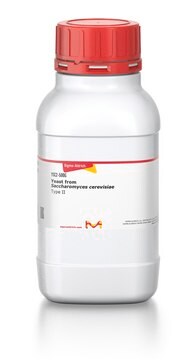
Yeast from Saccharomyces cerevisiae
Type I
Synonym(s):
(Bakers yeast)
Sign Into View Organizational & Contract Pricing
All Photos(3)
About This Item
UNSPSC Code:
12352202
NACRES:
NA.81
Recommended Products




biological source
Saccharomyces cerevisiae
Quality Level
type
Type I
form
powder or solid
application(s)
food and beverages
microbiology
storage temp.
2-8°C
General description
Yeast from Saccharomyces cerevisiae (Baker′s yeast) is the oldest microbial starter. It is a facultative anaerobe.
Application
Yeast from Saccharomyces cerevisiae has been used:
- as a biocatalyst for the anode of yeast microbial fuel cell
- for the production of ethanol for fuel use
- to prepare yeast extract
Biochem/physiol Actions
Yeast from Saccharomyces cerevisiae (Baker′s yeast) is used as a protein supplement, energy booster and immune enhancer. It serves as a dough leavening agent in bread production by converting the fermentable sugars to CO2 and ethanol. Baker′s yeast exhibits aroma, anti-molding and nutritive properties. It acts as a cell factory.
Caution
Autolyzes in aqueous buffer at 37 °C.
Preparation Note
Dried to avoid inactivation of enzymes.
Storage Class
11 - Combustible Solids
wgk_germany
WGK 3
flash_point_f
Not applicable
flash_point_c
Not applicable
ppe
Eyeshields, Gloves, type N95 (US)
Choose from one of the most recent versions:
Certificates of Analysis (COA)
Lot/Batch Number
Don't see the Right Version?
If you require a particular version, you can look up a specific certificate by the Lot or Batch number.
Already Own This Product?
Find documentation for the products that you have recently purchased in the Document Library.
Customers Also Viewed

Engineering baker?s yeast: room for improvement
Randez-Gil F, et al.
Trends in biotechnology, 17(6), 237-244 (1999)
Miniature flowing atmospheric-pressure afterglow ion source for facile interfacing of CE with MS
Jecklin MC, et al.
Electrophoresis, 31(21), 3597-3605 (2010)
Brewer's/baker's yeast (Saccharomyces cerevisiae) and preventive medicine: Part II
Moyad MA
Urologic Nursing, 28(1), 73-75 (2008)
Electrostatically enhanced performance of a yeast-based microbial fuel cell
Song Y, et al.
Royal Society of Chemistry Advances, 5(25), 19203-19205 (2015)
Inventions on baker's yeast strains and specialty ingredients
Gelinas P
Recent Patents on Food, Nutrition & Agriculture, 1(2), 104-132 (2009)
Protocols
This procedure may be used for the determination of Lyticase activity using Baker’s yeast as the substrate.
Our team of scientists has experience in all areas of research including Life Science, Material Science, Chemical Synthesis, Chromatography, Analytical and many others.
Contact Technical Service